Christopher Nolan is one of those filmmakers whose name alone can make me want to watch a movie. When I see “A Christopher Nolan Film,” I already expect something different: a complicated story, impressive visuals, great sound, time playing an important role, and a movie that may keep me thinking long after the credits.
What I find most interesting about Nolan is how his career has grown. He started with small, independent films where he did almost everything himself. Years later, he was making some of the biggest movies in Hollywood, including The Dark Knight, Inception, Interstellar, Oppenheimer, and now The Odyssey.
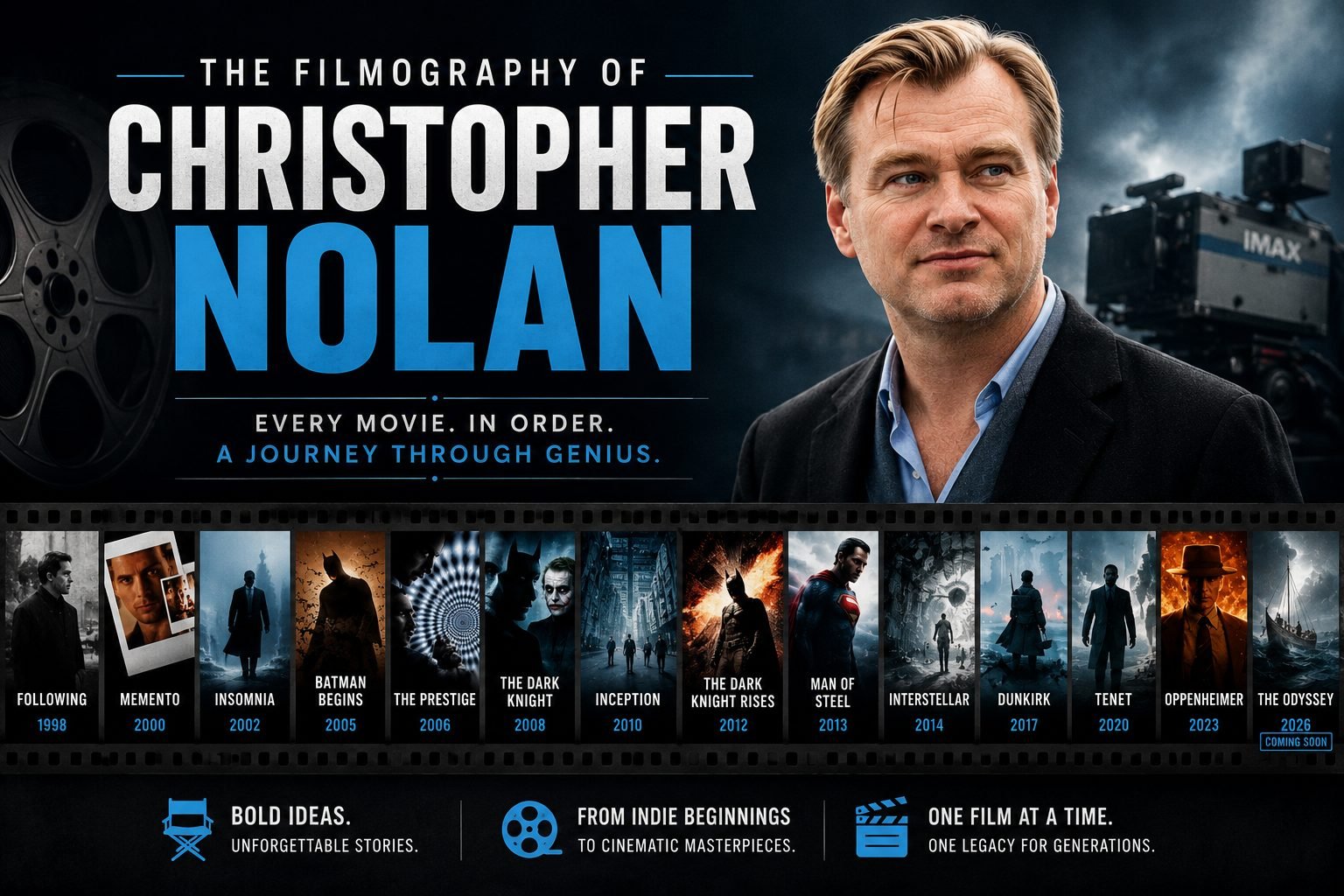
If you want to watch Christopher Nolan’s movies in order, this is the complete journey.
1. Following (1998)
Nolan’s feature-film career began with Following, a low-budget black-and-white thriller.
This is a very different Nolan from the one we know today. There are no massive explosions, huge sets or expensive visual effects. Instead, Nolan uses a simple story about a young man who follows strangers around London.
The movie is important because you can already see some of the ideas that would become common in Nolan’s later work: mystery, unreliable information, non-linear storytelling and characters who cannot always be trusted.
What makes Following even more impressive to me is how involved Nolan was. He directed, wrote, produced, photographed and edited the movie.
It was basically the beginning of the Nolan style.
2. Memento (2000)
Then came Memento, the movie that really put Christopher Nolan on the map.
The story follows Leonard Shelby, a man who has lost the ability to create new memories. He is trying to find the person responsible for a terrible crime, but remembering what happened becomes almost impossible.
The clever part is how Nolan tells the story. Instead of giving us events in a normal order, he makes the audience experience Leonard’s confusion.
For me, this is one of the best examples of Nolan making the structure of a movie part of the story itself.
Memento established Nolan as a filmmaker who was not afraid to make audiences work.
3. Insomnia (2002)
After Memento, Nolan moved into a much bigger Hollywood production with Insomnia.
The film stars Al Pacino, Robin Williams and Hilary Swank. Pacino plays a detective investigating a murder in Alaska, where the sun barely sets.
Unlike Memento, Insomnia was not written by Nolan. It was a remake of the 1997 Norwegian film of the same name.
Even though it was not originally Nolan’s story, the movie gave him experience working with major Hollywood stars and a larger production.
It was an important step between his independent beginnings and the blockbuster filmmaker he would become.
4. Batman Begins (2005)
This was the movie that changed Nolan’s career completely.
Batman Begins introduced Christian Bale as Bruce Wayne/Batman and gave the character a darker and more realistic treatment.
Instead of treating Batman purely as a comic-book superhero, Nolan focused heavily on Bruce Wayne’s fear, childhood trauma, training and motivation.
I particularly like how the movie asks a simple question: what would actually make someone become Batman?
The success of Batman Begins gave Nolan the opportunity to make something much bigger.
And that led to one of the greatest superhero movies ever made.
5. The Prestige (2006)
One year after Batman Begins, Nolan released The Prestige.
The movie follows two rival magicians, played by Christian Bale and Hugh Jackman, who become obsessed with defeating each other.
It is a movie about magic, but underneath that, it is really about obsession, sacrifice and how far people are willing to go to win.
This is one of those Nolan films that becomes more interesting after a second viewing. Once you understand what is happening, you start noticing things that you may have missed the first time.
6. The Dark Knight (2008)
Then came The Dark Knight. One of my best Christopher Nolan Movies.
I don’t think I need to exaggerate this movie. It is simply one of the most influential superhero films ever made.
Christian Bale returned as Batman, but Heath Ledger’s Joker became the center of much of the conversation.
The film was bigger, darker and more ambitious than Batman Begins. Nolan also treated the superhero story almost like a crime thriller.
For many people, including me, The Dark Knight remains Nolan’s most accessible movie. You can enjoy it as a Batman film, a crime movie or simply as a great character drama.
7. Inception (2010)
After Batman, Nolan decided to create something completely original.
That became Inception.
The basic idea is fascinating: a group of people can enter another person’s dreams and manipulate what happens inside them.
Leonardo DiCaprio leads the cast as Dom Cobb, a professional who enters people’s dreams while dealing with problems from his own past.
The movie combines science fiction, action and psychological drama.
The hallway fight scene, the spinning hotel and the famous ending have become part of modern movie culture.
For me, Inception is probably the clearest example of Nolan making a complicated idea feel like a huge Hollywood event.
8. The Dark Knight Rises (2012)
Nolan returned to Gotham for the final part of his Batman trilogy.
The Dark Knight Rises takes place years after the events of The Dark Knight. Bruce Wayne has retired from being Batman, but the arrival of Bane forces him back into action.
The film brought Nolan’s Batman story to an end.
It was a massive production and completed what is still one of the most respected superhero trilogies in cinema.
9. Man of Steel (2013)
Nolan did not direct Man of Steel, but he was heavily involved as a producer and helped develop the story.
Zack Snyder directed the movie, with Henry Cavill playing Superman.
Nolan’s involvement connected the film to the larger DC filmmaking world, even though it was not part of his Batman trilogy.
It is worth including in his filmography because producer and story credits are an important part of his career.
10. Interstellar (2014)
Interstellar is one of my favorite Nolan movies.
The film follows Cooper, played by Matthew McConaughey, a former pilot who travels into space looking for a new home for humanity.
But the movie is not only about space.
It is also about family, time, sacrifice and the relationship between parents and children.
The science can get complicated, especially when Nolan starts dealing with relativity, black holes and time. But emotionally, the story is quite simple: a father wants to save humanity and somehow find his way back to his children.
The music by Hans Zimmer also makes the movie feel even bigger.
11. Dunkirk (2017)
With Dunkirk, Nolan moved into historical filmmaking.
The movie tells the story of the evacuation of Allied soldiers from Dunkirk during World War II.
What makes it unusual is its structure. Nolan tells the story through different timelines, gradually bringing them together.
There is not a traditional hero at the center of everything. Instead, Nolan focuses on survival.
The movie is also a perfect example of his love for practical filmmaking, large-scale photography and sound.
12. Tenet (2020)
Tenet is probably one of Nolan’s most difficult movies to explain.
The main character is involved in an international mission involving technology that can reverse the direction of objects and people through time.
Yes, it gets complicated.
But that is part of the experience.
The film stars John David Washington, Robert Pattinson and Elizabeth Debicki, and it contains some incredible action sequences.
I remember watching Tenet and thinking that Nolan had once again decided that making things simple was not enough.
13. Oppenheimer (2023)
Then Nolan gave us Oppenheimer.
The film tells the story of J. Robert Oppenheimer, the physicist who became one of the central figures behind the development of the atomic bomb.
Cillian Murphy plays Oppenheimer, while the cast includes Robert Downey Jr., Emily Blunt and Matt Damon.
Unlike some of Nolan’s earlier movies, the biggest weapon here is not a superhero, spaceship or dream machine. It is history.
The movie mixes politics, science, personal relationships and moral questions.
It also became a major awards success. Oppenheimer received 13 Oscar nominations and won seven, including Best Picture and Best Director for Nolan.
For me, Oppenheimer showed how Nolan could take a historical subject and make it feel like an enormous cinematic event.
14. The Odyssey (2026)
And now we arrive at The Odyssey.
Nolan’s latest film is an adaptation of Homer’s ancient epic about Odysseus and his long journey home after the Trojan War.
Matt Damon plays Odysseus, with Anne Hathaway as Penelope, Tom Holland as Telemachus, Zendaya, Robert Pattinson, Lupita Nyong’o and Charlize Theron also starring.
What immediately caught my attention is the scale.
The Odyssey was shot entirely with IMAX cameras, making it the first film to achieve that feat. Universal describes it as a mythic action epic filmed across multiple locations around the world.
The movie was released on July 17, 2026, making it Nolan’s first feature after Oppenheimer.
And honestly, this feels like a very Nolan project: take an ancient story that everyone already knows and turn it into a massive theatrical experience.
Top 10 Steven Spielberg Movies I Recommend
Christopher Nolan’s Other Producing Work
Nolan has also worked as an executive producer on several films.
These include Transcendence (2014), Batman v Superman: Dawn of Justice (2016), Justice League (2017) and Zack Snyder’s Justice League (2021).
He was also credited as “Presented by” on Sanatorium Under the Sign of the Hourglass in 2024.
These projects show that Nolan’s influence extends beyond the movies he personally directs.
Christopher Nolan’s Short Films
Before becoming a famous feature-film director, Nolan made several short films.
His early short-film work includes:
- Tarantella (1989)
- Larceny (1996)
- Doodlebug (1997)
- Quay (2015)
- The Doll’s Breath (2019)
What’s interesting is that Nolan handled many jobs himself in his early career. He directed, wrote, produced, shot and edited several of these projects.
Doodlebug, in particular, is worth watching if you want to see a very early version of the filmmaker who would eventually make Inception and Tenet.
Nolan as Cinematographer and Editor
One thing I think people sometimes forget is that Nolan did not begin his career simply as “the director.”
On his early films, he was deeply involved in the technical side of filmmaking.
For Following, he worked as director, writer, producer, cinematographer and editor. He also served as cinematographer and editor on Larceny, Doodlebug and Quay.
This helps explain why his movies often feel so carefully controlled.
He understands not only the story but also the camera, editing and rhythm of a scene.
Christopher Nolan’s Documentary Appearances
Nolan has also appeared in several documentary projects, including These Amazing Shadows (2011), Side by Side (2012), Cinema Futures (2016), James Cameron’s Story of Science Fiction (2018), Making Waves: The Art of Cinematic Sound (2019), and Hans Zimmer & Friends: Diamond in the Desert (2025).
My Take on Christopher Nolan’s Filmography
Looking at Nolan’s career in order, what stands out to me is the progression.
He started with a tiny black-and-white thriller.
Then he made Memento, which established his reputation.
He moved into Hollywood with Insomnia, reinvented Batman with Batman Begins, made a classic with The Dark Knight, created an original blockbuster with Inception, went into space with Interstellar, tackled World War II with Dunkirk, experimented with time in Tenet, brought history to the screen with Oppenheimer, and finally turned to one of the oldest stories ever told with The Odyssey.
That is an incredible journey.
What I personally appreciate most about Nolan is that he still believes audiences can keep up with complicated movies. He doesn’t always explain everything. Sometimes he gives you the puzzle and expects you to put the pieces together yourself.
That may frustrate some viewers, but for me, it is part of the fun.
If you are new to Christopher Nolan, I would not simply recommend watching his movies randomly. Watch them in release order. You can actually see his filmmaking grow from a young director working with limited resources into one of the biggest filmmakers in the world.
And if you have already watched most of his movies, watching them again in this order can give you a different appreciation for his career.
From Following to The Odyssey, Christopher Nolan’s filmography is essentially the story of a filmmaker who kept asking, “How much further can I take this?”
And somehow, he keeps finding an answer.
 James
James