Some movie ideas sound so simple that you immediately want to know what happens next.
What if you woke up one morning and discovered that you could not leave your house?
Not because you were sick.
Not because there was a government lockdown.
But because something outside had made it physically impossible to open the doors or windows.
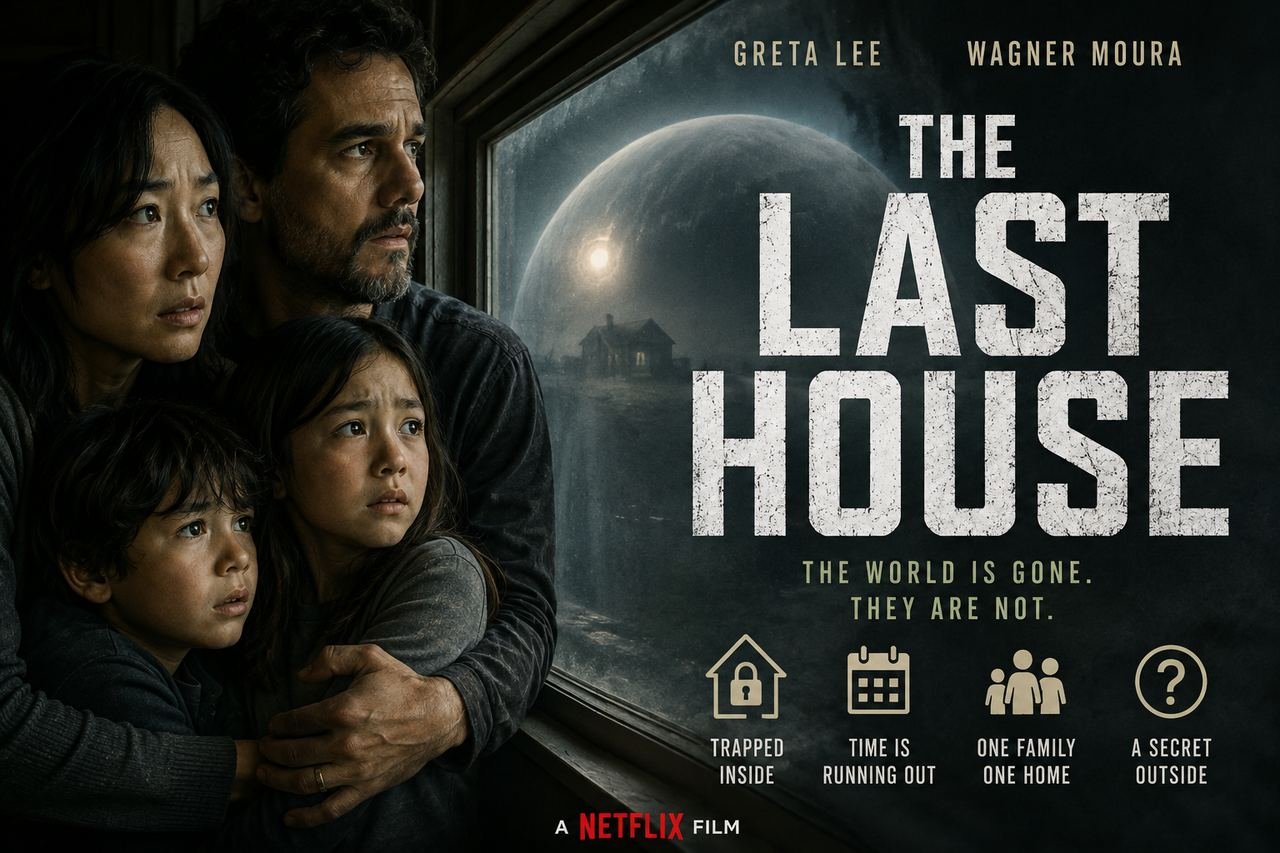
That is the basic idea behind The Last House, the 2026 Netflix sci-fi thriller directed by Louis Leterrier and starring Greta Lee and Wagner Moura.
The story follows a family of four who suddenly become trapped inside their home. They have food, water and a place to sleep, but they have no idea how long the situation will last or what exactly is keeping them inside.
At first, it feels like a strange inconvenience.
Then the days become weeks.
The weeks become months.
And eventually, the family realizes they may have to live this way for years.
My take? The Last House has a really good idea at its center, and the first half made me genuinely curious. Unfortunately, I think the movie becomes weaker the more it explains its mystery.
Still, there is enough here to make it worth talking about.
The Premise Is the Best Part
The first thing that attracted me to The Last House was the premise.
Imagine being inside your own home and suddenly realizing you can’t leave.
You try the front door.
Nothing.
You try the windows.
Nothing.
You try breaking the glass.
It repairs itself.
Then you realize your phone isn’t working.
The internet is gone.
You can’t communicate with the outside world.
And you have no idea whether the problem will last for a few hours or the rest of your life.
That’s a terrifying situation.
The movie does a good job making that initial discovery uncomfortable.
The family doesn’t immediately know what is happening, and neither does the audience.
That mystery kept me watching.
Greta Lee and Wagner Moura Carry the Movie
The biggest reason the movie remains watchable is its two leads.
Greta Lee plays Ann, while Wagner Moura plays Jason.
Both actors bring enough personality to the family that you can understand why the situation affects each of them differently.
Jason is practical and focused on survival.
Ann is dealing with the emotional side of what is happening.
They are both trying to protect their children while also trying to understand what has happened to the world outside.
Wagner Moura probably impressed me the most.
There is an intensity to his performance that works particularly well once Jason realizes that simply waiting for help isn’t going to solve anything.
Several critics also pointed to Moura as one of the movie’s strongest elements. RogerEbert.com said he brings an immediacy to the role that helps him stand out, while other reviews praised the chemistry between Moura and Lee.
And I agree.
Without these two actors, I think the movie would have been much harder to sit through.
The Family Dynamic Is Interesting
The movie isn’t only about escaping the house.
It is also about what happens when a family is forced to live together under extreme pressure.
At the beginning, they are simply trying to figure out what happened.
Then they start rationing food.
They find ways to grow some of their own food.
They try to keep themselves entertained.
They develop routines.
But eventually, the situation starts changing them.
This is where I think the movie has something interesting to say.
Being trapped with the people you love sounds comforting until you realize that there is no break.
No going for a walk.
No visiting a friend.
No going to work.
No school.
No restaurant.
No vacation.
Just the same four walls every day.
For years.
That would test almost any family.
It Feels Like a Nightmare Version of Lockdown
The connection to the COVID-19 lockdown is impossible to miss.
The difference is that during lockdown, people could eventually leave their homes.
In The Last House, the family physically cannot.
The movie takes the familiar feelings of isolation, boredom and uncertainty and pushes them much further.
The early scenes actually reminded me of the strange period when people were stuck at home and didn’t know how long things would continue.
Except here, there is no announcement telling everyone when the restrictions will end.
There isn’t even anyone to tell them what is happening.
The Guardian also viewed the film as a post-COVID lockdown thriller, noting how the story moves from everyday frustrations into a much darker survival situation.
That is probably one of the movie’s strongest ideas.
I Like the Way Time Passes
One of the more interesting decisions is that the story doesn’t remain stuck on the first day.
Time moves forward.
Days become weeks.
Weeks become months.
Eventually, years pass.
That changes the entire meaning of the story.
At first, the family is waiting for the situation to end.
After a while, they realize they have to create a life inside the house.
That is much more interesting than simply watching four people panic for two hours.
The family grows.
The children change.
The parents change.
Their relationships change.
Their house changes.
Their understanding of the world changes.
A detailed review from 10th Circle praised this structure, particularly the way the film turns confinement from a temporary emergency into a way of life.
For me, that is one of the best things about the movie.
Then the Movie Starts Losing Me
Unfortunately, this is where my opinion changes.
The first half made me think I might be watching a really clever sci-fi thriller.
The second half made me start asking questions that the movie didn’t always answer.
What exactly is happening?
Why is it happening?
What are the creatures?
Why does the house behave the way it does?
Why are some things possible while others aren’t?
I don’t mind movies leaving some questions unanswered.
Mystery can be a good thing.
But there is a difference between mystery and confusion.
And The Last House sometimes crosses that line.
The Creatures Are an Interesting Idea
Without getting too deep into spoilers, the movie eventually reveals that the family isn’t simply dealing with some strange weather phenomenon.
There are mysterious aquatic creatures involved.
This is where the movie shifts from psychological survival thriller into creature-driven science fiction.
I don’t necessarily hate that decision.
In fact, I think it could have worked extremely well.
The problem is that I don’t think the movie explains enough about these creatures to make their behavior completely satisfying.
You spend so much time wondering what is outside that you naturally expect the eventual explanation to be impressive.
For me, it wasn’t quite there.
The Movie Becomes More Unbelievable
This is my biggest criticism.
The basic premise requires you to accept something impossible.
That’s fine.
Movies are allowed to do that.
But once you establish a set of rules for your fictional world, those rules need to feel consistent.
There are several moments where I found myself thinking:
Wait, how does that work?
Some critics had similar complaints.
RogerEbert.com criticized the movie’s lack of depth and its failure to make the high-concept setup fully satisfying.
Decider went even further, pointing to several plot and logic problems that undermine the movie’s lockdown metaphor.
I don’t think you need to explain every little detail in a sci-fi movie.
But when the movie itself starts giving explanations, those explanations need to make sense.
The House Becomes a Prison
The title becomes more meaningful as the story progresses.
At the beginning, the house is a home.
It is safe.
It protects the family.
It contains everything they need.
But gradually, it becomes a prison.
That transformation is one of the strongest parts of the movie.
The same walls that once made the family feel secure now prevent them from escaping.
The kitchen becomes a place where food has to be carefully managed.
The children’s rooms become reminders of how much time has passed.
The windows become something they can look through but cannot use.
The house itself almost becomes another character.
The Children Add Another Layer
I also liked the decision to show the children growing older.
The movie doesn’t simply keep them the same age for the entire story.
As time passes, they change.
That creates another problem for the parents.
They aren’t just trying to keep their children alive.
They’re trying to raise them in a world where normal childhood doesn’t exist.
Imagine being a child and growing up without ever leaving your home.
Imagine learning about the outside world from stories, memories and whatever information your parents can provide.
That is much darker than simply being trapped for a few weeks.
There Are Some Good Emotional Moments
Despite my complaints about the plot, there are moments when the movie gets the emotional side right.
Jason and Ann aren’t always going to agree.
They have different ideas about survival.
They disagree about risks.
They sometimes react differently to the children.
And that feels believable.
When people are under extreme pressure, love doesn’t automatically make disagreements disappear.
Sometimes pressure makes them worse.
The movie understands that.
The family isn’t perfectly united all the time.
They fight.
They make mistakes.
They get frustrated.
But they still need one another.
That gives the movie some heart.
The Final Act Is My Biggest Problem
This is where I think The Last House could have been much better.
The movie spends a long time building a mystery.
You are waiting to discover what is happening outside.
You are waiting to understand the creatures.
You are waiting to see whether the family will escape.
Then the final act arrives.
There are some exciting moments, but the explanation didn’t completely satisfy me.
The movie suddenly becomes more focused on action and survival than the psychological tension that made the first half interesting.
The Guardian made a similar observation, arguing that the first half builds tension effectively before the second half becomes a less satisfying sci-fi horror story.
That is exactly how I felt.
But I Like What the Ending Is Trying to Say
The ending itself has an interesting idea.
Without giving away every detail, the family’s survival eventually connects to an act of mercy.
That is important.
The movie spends so much time showing people trying to survive by controlling their environment.
But in the end, compassion becomes more important than force.
I thought that was a good message.
The execution could have been better, but the idea itself works.
The family learns that not everything outside their house is automatically their enemy.
And that changes the way they understand the creatures.
Is The Last House Scary?
Not really.
At least, not in the traditional horror sense.
There are frightening moments.
There is tension.
There are creatures.
There are scenes where the family is clearly in danger.
But I wouldn’t call this a terrifying horror movie.
The real fear comes from the idea of being trapped.
What would you do if you couldn’t leave your house for five years?
How would you keep your children happy?
How would you get food?
What happens when someone gets seriously sick?
What happens when the house starts falling apart?
Those questions are more frightening than the creatures themselves.
Some Critics Really Didn’t Like It
The movie has received a mixed response.
RogerEbert.com gave it a harsh review, criticizing the shallow characters and the lack of meaningful development.
NME also criticized the movie’s melodrama and found the later horror elements frustrating.
TheWrap described it as a contrived thriller that benefits from the star power of Greta Lee and Wagner Moura.
At the same time, other reviews have been more forgiving, particularly toward the performances and the movie’s central concept.
I understand both sides.
The movie has a genuinely interesting idea.
I just don’t think the screenplay gets as much out of that idea as it could have.
Would I Recommend It?
Yes, but with some hesitation.
If you like survival movies, mystery thrillers, creature movies or stories about families trapped in impossible situations, I think it is worth giving a chance.
If you want a movie where every mystery gets a satisfying explanation, you may become frustrated.
And if you’re expecting something genuinely terrifying, you may be disappointed.
For me, the best reason to watch is the premise and the performances.
Greta Lee and Wagner Moura make the family believable enough to keep you invested.
My Final Take
The Last House is a movie with a great idea that doesn’t completely live up to its potential.
The opening is strong.
The premise immediately grabs your attention.
The family dynamic works.
The performances are good.
And the gradual passage of time gives the story a surprisingly emotional side.
But the movie loses some of that strength when it starts explaining the larger mystery.
The creatures are interesting, but the rules surrounding them aren’t always clear.
The final act has some good ideas, but it doesn’t deliver the payoff I wanted after spending so much time waiting for answers.
Still, I don’t think The Last House is a complete waste of time.
In fact, I think it is one of those movies that could lead to a much better conversation after the credits than it provides while you’re watching it.
You may finish it and immediately start asking:
What would I do if I were trapped in that house?
Would I ration the food?
Would I try to break out?
Would I accept that this might be my new life?
Would I trust the creatures?
And most importantly, how long could my family stay together before the pressure became too much?
Those questions are more interesting to me than some of the movie’s answers.
My rating: 6.5/10.
Good concept.
Good performances.
Some strong tension.
A few genuinely interesting ideas.
But the movie needed a stronger script and a more satisfying explanation of its central mystery.
If you have Netflix and like strange sci-fi thrillers, I’d still say give The Last House a chance.
Just don’t expect every question to have a perfect answer.
 James
James