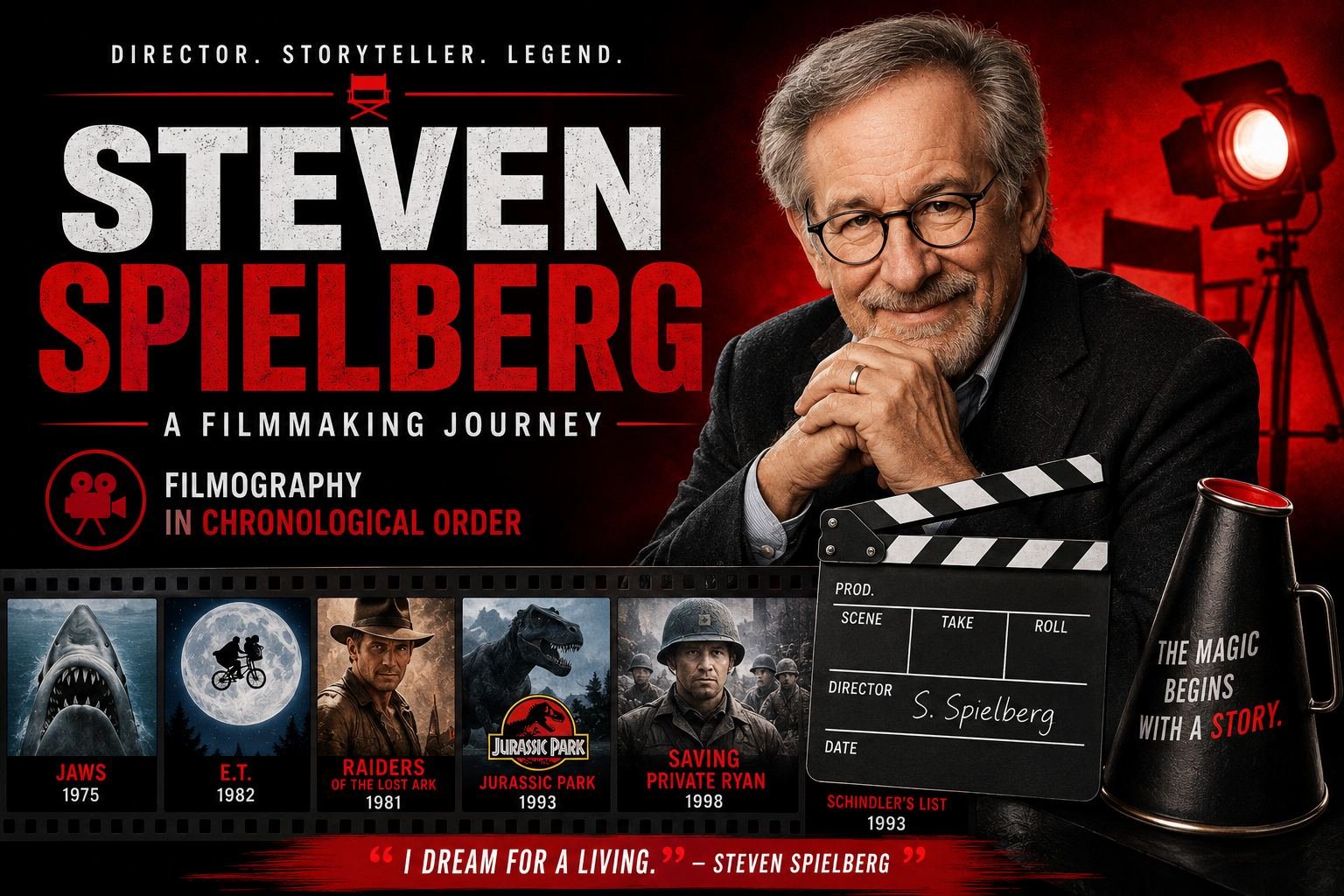
Steven Spielberg is one of the most important filmmakers in the history of cinema. His name is connected with some of the biggest movies ever made, including Jaws, E.T. the Extra-Terrestrial, Indiana Jones, Jurassic Park, Schindler’s List and Saving Private Ryan.
But Spielberg’s career did not begin with a huge Hollywood movie. It started when he was still a teenager, making short films with very limited resources.
If you want to understand Spielberg properly, the best way is to look at his filmography in chronological order. His career moves from homemade short films to television, then to blockbuster movies, serious historical dramas, science fiction, adventure, animation and many films he produced for other directors.
IMDb currently lists Spielberg with dozens of directing, producing, writing and acting credits, showing just how wide his career has been.
1959–1968: The Young Spielberg
1959 – The Last Gun
This was one of Spielberg’s earliest filmmaking efforts. It was a short Western that showed that young Spielberg was already interested in telling stories through a camera.
1961 – Fighter Squad
Spielberg continued experimenting with filmmaking with this short World War II-inspired project.
1961 – Escape to Nowhere
Another early short film, Escape to Nowhere showed Spielberg’s interest in war stories. He was still a teenager when he made these early films.
1964 – Firelight
Firelight was especially interesting because it dealt with aliens invading a small town. Even at this early stage, Spielberg was already playing with the science-fiction ideas that would later become a major part of his career.
1968 – Amblin’
Amblin’ was an important step toward Spielberg’s professional career. The short film helped him get noticed in Hollywood.
Looking back, these early projects are fascinating because you can see the filmmaker he would eventually become beginning to take shape.
1971–1979: Spielberg Becomes a Hollywood Director
1971 – Duel
Duel was one of the major turning points in Spielberg’s career.
The story is simple: a man driving on the road is followed and threatened by a mysterious truck driver.
That simple idea becomes a tense thriller.
The movie showed Spielberg’s ability to create suspense without needing complicated stories or huge sets. It helped establish him as a director to watch.
1974 – The Sugarland Express
Spielberg’s first theatrical feature was The Sugarland Express, a crime drama starring Goldie Hawn.
It was not the enormous commercial success that some of his later films would become, but it gave him his first major opportunity to work on a feature film.
1975 – Jaws
Then came Jaws.
This changed everything.
The movie about a giant shark attacking a beach community became a worldwide phenomenon and helped create the modern summer blockbuster.
Spielberg suddenly went from a promising young director to one of Hollywood’s biggest names.
1977 – Close Encounters of the Third Kind
Spielberg followed Jaws with a very different kind of movie.
Close Encounters of the Third Kind was about humanity’s encounter with mysterious extraterrestrial beings.
Instead of focusing mainly on fear, Spielberg created a movie filled with wonder, mystery and curiosity.
1978 – I Wanna Hold Your Hand
Spielberg produced this comedy about young people trying to meet The Beatles.
1979 – 1941
1941 was Spielberg’s attempt at a huge comedy set during World War II.
It was much less successful than Jaws or Close Encounters, but it remains an interesting part of his career because it showed that Spielberg was willing to take risks.
1980–1989: The Spielberg Era
This decade is where Spielberg’s filmography becomes almost unbelievable.
1981 – Raiders of the Lost Ark
Spielberg teamed up with George Lucas to bring Indiana Jones to the big screen.
Harrison Ford played archaeologist Indiana Jones, and the movie combined adventure, action, comedy and ancient mysteries.
Raiders of the Lost Ark became one of the defining adventure movies of its generation.
1982 – E.T. the Extra-Terrestrial
Then Spielberg gave audiences E.T.
The story of a lonely boy who becomes friends with an alien became one of the most beloved films of the 1980s.
Spielberg also produced the film, making his involvement even deeper.
1982 – Poltergeist
Spielberg produced and co-wrote Poltergeist, a supernatural horror film directed by Tobe Hooper.
1983 – Twilight Zone: The Movie
Spielberg directed one segment and also served as a producer.
1984 – Indiana Jones and the Temple of Doom
Spielberg returned with another Indiana Jones adventure.
This film was darker and more intense than Raiders of the Lost Ark, but it became another major success.
See>>> Top 10 Steven Spielberg Movies I Recommend
1985 – The Color Purple
Spielberg moved into serious drama with The Color Purple, starring Whoopi Goldberg, Danny Glover and Oprah Winfrey.
The movie showed another side of his directing ability.
1985 – The Goonies
Spielberg produced The Goonies, an adventure movie about children searching for treasure.
1987–1988 – More Producing Work
During this period Spielberg produced several successful movies, including An American Tail, The Money Pit, batteries not included, Innerspace, The Land Before Time and Who Framed Roger Rabbit.
One important thing about Spielberg’s filmography is that you should not only look at the movies he directed.
He was also helping other filmmakers make successful movies.
1987 – Empire of the Sun
Spielberg returned to directing with Empire of the Sun, a serious war drama starring a young Christian Bale.
1989 – Indiana Jones and the Last Crusade
Spielberg reunited with Harrison Ford for what many fans consider one of the strongest Indiana Jones films.
This time, Sean Connery played Indiana Jones’ father.
The combination of action, humour and the relationship between father and son gave the movie something more than just adventure.
1990–1999: Dinosaurs, War and History
1991 – Hook
Spielberg gave the Peter Pan story a new direction with Hook, starring Robin Williams as an adult Peter Pan.
1993 – Jurassic Park
Then came another movie that changed cinema.
Jurassic Park brought dinosaurs to life in a way audiences had never seen before.
The movie combined computer-generated effects, practical effects, adventure and Spielberg’s talent for making audiences care about the characters.
It became one of the defining films of the 1990s.
1993 – Schindler’s List
In the same year, Spielberg released Schindler’s List.
The movie told the story of Oskar Schindler and his efforts to save Jewish people during the Holocaust.
It was very different from Jurassic Park.
One film gave audiences dinosaurs and adventure. The other dealt with one of the darkest periods in human history.
Yet both came from the same director.
Schindler’s List became one of Spielberg’s most respected films and won the Academy Award for Best Picture, while Spielberg won the Oscar for Best Director. The story is actually based on true story.
1997 – The Lost World: Jurassic Park
Spielberg returned to the world of dinosaurs with The Lost World: Jurassic Park.
1997 – Amistad
Spielberg then directed Amistad, a historical drama based on the story of enslaved Africans who fought for their freedom after being transported to America.
1998 – Saving Private Ryan
Spielberg returned to World War II with Saving Private Ryan.
The movie follows a group of soldiers sent behind enemy lines to find and bring home Private Ryan.
Its opening battle sequence became famous for its brutal and realistic presentation of war.
The movie also showed how Spielberg could combine large-scale action with deeply emotional storytelling.
2000–2009: Science Fiction, History and Big Ideas
2001 – A.I. Artificial Intelligence
Spielberg entered the world of artificial intelligence with A.I., a science-fiction drama about a robotic child who wants to become human.
The project had originally been associated with Stanley Kubrick, and Spielberg eventually directed it after Kubrick’s death.
2002 – Minority Report
Tom Cruise starred in this futuristic thriller about a police system that attempts to stop crimes before they happen.
2002 – Catch Me If You Can
Spielberg then moved into a lighter story.
Leonardo DiCaprio played Frank Abagnale Jr., a young man who successfully impersonated different professionals while staying ahead of the FBI.
2004 – The Terminal
Tom Hanks starred in The Terminal, the story of a man who becomes trapped inside an airport because he cannot legally enter the country or return home.
It was another example of Spielberg mixing humour with human emotion.
2005 – War of the Worlds
Spielberg reunited with Tom Cruise for a modern version of H.G. Wells’ famous alien-invasion story.
2005 – Munich
Munich was a much more serious film, dealing with the aftermath of the 1972 Munich Olympics massacre.
2008 – Indiana Jones and the Kingdom of the Crystal Skull
Spielberg returned to the Indiana Jones franchise with Harrison Ford.
The movie brought the character into a new era while introducing a new generation of viewers to Indiana Jones.
2009 – The Lovely Bones
Spielberg produced The Lovely Bones, directed by Peter Jackson.
Again, this is a good reminder that Spielberg’s career extends far beyond the films he personally directed.
2010–2013: A Mature Spielberg
2011 – Super 8
Spielberg produced Super 8, directed by J.J. Abrams.
The film had a strong Spielberg-style feeling, combining young characters, mystery, science fiction and adventure.
2011 – The Adventures of Tintin
Spielberg directed The Adventures of Tintin, an animated adventure using motion-capture technology.
2011 – War Horse
Spielberg also directed War Horse, a World War I drama told partly through the relationship between a young man and his horse.
2012 – Lincoln
Spielberg turned his attention to American history again with Lincoln.
Daniel Day-Lewis played President Abraham Lincoln, focusing on the political battle surrounding the abolition of slavery.
2013 – Robopocalypse
Spielberg was attached to direct Robopocalypse, although the project did not become a released film at that time.
Steven Spielberg Filmography: 2015–2026
After Robopocalypse was announced in 2013, Spielberg’s career continued in a different direction. Rather than focusing mainly on science fiction and huge action movies, he returned to historical dramas, fantasy, politics and stories about filmmaking itself.
And if you have followed Spielberg’s career from the beginning, this later period is interesting because it shows that even after decades in Hollywood, he was still willing to try different types of stories.
2015 – Bridge of Spies
Spielberg returned to the big screen with Bridge of Spies, a Cold War thriller starring Tom Hanks.
The story follows James B. Donovan, an American lawyer who becomes involved in a complicated prisoner exchange between the United States and the Soviet Union.
It was another collaboration between Spielberg and Tom Hanks, following their work together on Saving Private Ryan, Catch Me If You Can and The Terminal.
The movie is not a traditional action film. Instead, Spielberg builds the tension through conversations, politics and the danger surrounding the characters.
For me, this is one of the movies that shows Spielberg’s strength as a storyteller. He can take something that sounds complicated and make it easy to follow.
2016 – The BFG
Spielberg changed direction again with The BFG, based on the famous children’s book by Roald Dahl.
The movie follows a young girl named Sophie who meets a friendly giant.
Unlike the darker historical stories Spielberg had recently made, The BFG is aimed more at families and younger audiences.
It also allowed Spielberg to return to something that has appeared throughout his career: children discovering a world much bigger and stranger than they expected.
2017 – The Post
In 2017, Spielberg directed The Post, a political drama starring Meryl Streep and Tom Hanks.
The story is based on the publication of the Pentagon Papers by American newspapers.
Meryl Streep plays Katharine Graham, publisher of The Washington Post, while Tom Hanks plays editor Ben Bradlee.
The movie focuses on journalism, government secrets and the difficult decision of whether newspapers should publish information that the government does not want the public to see.
It was another example of Spielberg returning to an important period in American history.
2018 – Ready Player One
Spielberg went back into science fiction and adventure with Ready Player One.
Based on Ernest Cline’s novel, the movie takes place in a future where people spend much of their lives inside a massive virtual world called the OASIS.
The story mixes science fiction with video-game culture and references to popular movies, music and television.
For someone familiar with Spielberg’s earlier movies, Ready Player One is particularly interesting because it contains many ideas connected to the kind of popular entertainment that helped define his own career.
It was also Spielberg’s first major science-fiction adventure film since War of the Worlds in 2005.
2019 – Producing More Films
Spielberg did not direct a feature film in 2019, but he continued to work as a producer.
His producing credits included projects such as Men in Black: International and Cats.
This is an important part of understanding Spielberg’s career.
Even when he is not sitting in the director’s chair, he continues to have a role in Hollywood productions. His filmography therefore contains many more movies than the ones he personally directed.
2021 – West Side Story
After a few years away from directing, Spielberg returned with West Side Story.
This was a new film version of the famous Broadway musical and the 1961 movie.
The story follows Tony and María, two young people from rival groups who fall in love despite the conflict around them.
Spielberg’s decision to direct a musical was interesting because it was not the kind of movie most people would immediately expect from the director of Jaws and Jurassic Park.
But Spielberg had always been interested in music, performance and visual storytelling.
The movie received strong reviews and showed that even after more than 50 years in the business, Spielberg was still prepared to take on a different genre.
2022 – The Fabelmans
In 2022, Spielberg made perhaps his most personal movie.
The Fabelmans is a semi-autobiographical story inspired by Spielberg’s childhood and his discovery of filmmaking.
The main character, Sammy Fabelman, is a young boy who becomes fascinated with movies.
As Sammy grows older, he begins using his camera to understand the world around him and the problems within his family.
If you have watched Spielberg’s filmography from the beginning, The Fabelmans feels almost like looking behind the curtain.
Instead of Spielberg telling us about sharks, aliens, dinosaurs or war, he tells us about the boy who wanted to make movies.
That makes the film especially important when looking at his career as a whole.
Spielberg directed, produced and co-wrote the movie.
2023 – Spielberg as Producer
Spielberg did not direct a feature film in 2023, but he remained active as a producer.
His credits included Indiana Jones and the Dial of Destiny, The Color Purple and Transformers: Rise of the Beasts.
These projects also show the range of Spielberg’s producing career.
He could be involved with a major action franchise, a musical drama and a science-fiction blockbuster in the same period.
2024 – Transformers One
Spielberg served as an executive producer on Transformers One, an animated movie set in the world of the Transformers.
The film tells the early story of Optimus Prime and Megatron before they became enemies.
Although Spielberg did not direct it, his producing connection continues his long relationship with the Transformers franchise.
He had previously served as executive producer on several live-action Transformers movies.
2024 – Music by John Williams
Spielberg also appeared in and helped produce Music by John Williams, a documentary about the legendary composer John Williams.
This connection is particularly meaningful because Williams and Spielberg have had one of the longest-running director-composer partnerships in Hollywood.
Williams created the music for many of Spielberg’s most famous films, including Jaws, E.T., Indiana Jones, Jurassic Park, Schindler’s List and Saving Private Ryan.
So a documentary about Williams also gives viewers a chance to see the relationship between two major figures in Spielberg’s career.
2025 – Jurassic World Rebirth
Spielberg returned to the dinosaur world as an executive producer on Jurassic World Rebirth.
The film continues the Jurassic franchise, although Spielberg was not the director.
That distinction is worth remembering.
Spielberg directed the original Jurassic Park in 1993 and The Lost World: Jurassic Park in 1997. In the later Jurassic World movies, his role has mainly been as a producer or executive producer.
2025 – Hamnet
Spielberg also served as a producer on Hamnet, a historical drama based on the novel by Maggie O’Farrell.
The film focuses on the family life surrounding William Shakespeare and his wife Agnes.
Again, Spielberg was not the director. His role was as producer.
2025 – The Thursday Murder Club
Spielberg was also credited as a producer on The Thursday Murder Club, a mystery comedy based on Richard Osman’s bestselling novel.
The story follows a group of older friends who become involved in solving a murder.
It is another example of Spielberg continuing to work behind the scenes on different kinds of films.
2026 – Disclosure Day
Spielberg returns to directing with Disclosure Day, a new science-fiction film.
The project is particularly interesting because science fiction has been one of the most important genres throughout Spielberg’s career.
His earlier science-fiction movies include Close Encounters of the Third Kind, E.T. the Extra-Terrestrial, A.I. Artificial Intelligence, Minority Report and War of the Worlds.
Disclosure Day therefore represents another return to familiar territory for the filmmaker.
As of 2026, it is listed as a Spielberg directing and producing project.
Why Spielberg’s Filmography Is So Special
What makes Spielberg’s career interesting is not simply the number of movies he has worked on.
It is the variety.
He has made films about sharks, aliens, dinosaurs, archaeologists, soldiers, presidents, robots, children, criminals and historical events.
He can make a movie that feels like pure entertainment and then make another movie that asks serious questions about war, racism, humanity and morality.
That ability is probably the easiest way to understand Spielberg’s career.
He knows how to tell a story in a way that is easy to follow, but he also knows how to make audiences feel something.
His biggest films are often built around simple ideas. A giant shark threatens a beach.
A boy meets an alien.
Dinosaurs come back to life.
An archaeologist searches for an ancient treasure.
A group of soldiers tries to save one man.
But Spielberg turns those simple ideas into memorable cinematic experiences.
Steven Spielberg’s Later Career in Simple Terms
Looking at Spielberg’s career after 2013, there is an interesting pattern.
He did not simply keep making giant blockbuster movies.
Instead, he moved between different kinds of filmmaking.
He made:
- Historical drama – Bridge of Spies
- Family fantasy – The BFG
- Political drama – The Post
- Science fiction – Ready Player One
- Musical – West Side Story
- Personal drama – The Fabelmans
- Science fiction again – Disclosure Day
At the same time, he continued producing films for other directors.
This is important because Spielberg’s career cannot be measured only by the movies where his name appears as director.
He has spent decades helping create movies from behind the scenes as well.
Steven Spielberg’s Complete Directing Journey
If we focus only on his feature films as director, the journey becomes easier to see.
It starts with:
1974 – The Sugarland Express
Then:
1975 – Jaws
1977 – Close Encounters of the Third Kind
1979 – 1941
1981 – Raiders of the Lost Ark
1982 – E.T. the Extra-Terrestrial
1983 – Twilight Zone: The Movie
1984 – Indiana Jones and the Temple of Doom
1985 – The Color Purple
1987 – Empire of the Sun
1989 – Indiana Jones and the Last Crusade
1989 – Always
1991 – Hook
1993 – Jurassic Park
1993 – Schindler’s List
1997 – The Lost World: Jurassic Park
1997 – Amistad
1998 – Saving Private Ryan
2001 – A.I. Artificial Intelligence
2002 – Minority Report
2002 – Catch Me If You Can
2004 – The Terminal
2005 – War of the Worlds
2005 – Munich
2008 – Indiana Jones and the Kingdom of the Crystal Skull
2011 – The Adventures of Tintin
2011 – War Horse
2012 – Lincoln
2015 – Bridge of Spies
2016 – The BFG
2017 – The Post
2018 – Ready Player One
2021 – West Side Story
2022 – The Fabelmans
2026 – Disclosure Day
This list makes something very clear: Spielberg has never stayed in one lane for very long.
Steven Spielberg Filmography in Chronological Order
| Year | Film / Project | Spielberg’s Role |
|---|---|---|
| 1959 | The Last Gun | Director, Actor |
| 1961 | Fighter Squad | Director, Writer |
| 1961 | Escape to Nowhere | Director, Producer, Writer |
| 1964 | Firelight | Director, Writer |
| 1968 | Amblin’ | Director, Writer |
| 1971 | Duel | Director |
| 1972 | Something Evil | Director |
| 1974 | The Sugarland Express | Director, Writer |
| 1975 | Jaws | Director, Writer |
| 1977 | Close Encounters of the Third Kind | Director, Writer |
| 1978 | I Wanna Hold Your Hand | Producer |
| 1979 | 1941 | Director |
| 1980 | The Blues Brothers | Actor — Cook County Assessor’s Office Clerk |
| 1980 | Used Cars | Producer |
| 1981 | Continental Divide | Producer |
| 1981 | Raiders of the Lost Ark | Director |
| 1982 | E.T. the Extra-Terrestrial | Director, Producer |
| 1982 | Poltergeist | Producer, Writer |
| 1983 | Twilight Zone: The Movie | Director, Producer |
| 1984 | Gremlins | Producer, Actor |
| 1984 | Indiana Jones and the Temple of Doom | Director |
| 1984 | Room 666 | Actor — Himself |
| 1985 | Fandango | Producer |
| 1985 | Back to the Future | Producer |
| 1985 | The Color Purple | Director, Producer |
| 1985 | The Goonies | Producer, Writer |
| 1985 | Young Sherlock Holmes | Producer |
| 1986 | An American Tail | Producer |
| 1986 | The Money Pit | Producer |
| 1987 | batteries not included | Producer |
| 1987 | Empire of the Sun | Director, Producer |
| 1987 | Harry and the Hendersons | Producer |
| 1987 | Innerspace | Producer |
| 1987 | Three O’Clock High | Producer |
| 1988 | The Land Before Time | Producer |
| 1988 | Who Framed Roger Rabbit | Producer |
| 1989 | Always | Director, Producer |
| 1989 | Back to the Future Part II | Producer |
| 1989 | Dad | Producer |
| 1989 | Indiana Jones and the Last Crusade | Director |
| 1990 | Arachnophobia | Producer |
| 1990 | Dreams | Producer |
| 1990 | Back to the Future Part III | Producer |
| 1990 | Gremlins 2: The New Batch | Producer |
| 1990 | Joe Versus the Volcano | Producer |
| 1990 | Roller Coaster Rabbit | Producer |
| 1991 | A Wish for Wings That Work | Producer |
| 1991 | An American Tail: Fievel Goes West | Producer |
| 1991 | Cape Fear | Producer |
| 1991 | Hook | Director |
| 1991 | Tiny Toon Adventures: How I Spent My Vacation | Producer |
| 1991 | A Brief History of Time | Producer |
| 1993 | Jurassic Park | Director, Producer |
| 1993 | We’re Back! A Dinosaur’s Story | Producer |
| 1993 | Schindler’s List | Director, Producer |
| 1994 | The Flintstones | Producer |
| 1995 | Casper | Producer |
| 1995 | Balto | Producer |
| 1996 | Twister | Producer |
| 1997 | The Lost World: Jurassic Park | Director, Actor — Cameo |
| 1997 | Men in Black | Producer |
| 1997 | Amistad | Director, Producer |
| 1998 | Saving Private Ryan | Director, Producer |
| 1998 | The Last Days | Producer |
| 1998 | The Mask of Zorro | Producer |
| 1998 | Deep Impact | Producer |
| 1999 | Wakko’s Wish | Producer |
| 2000 | Shooting War | Producer |
| 2001 | A.I. Artificial Intelligence | Director, Producer, Writer |
| 2001 | Jurassic Park III | Producer |
| 2001 | Stanley Kubrick: A Life in Pictures | Actor — Himself |
| 2001 | Vanilla Sky | Actor — Himself |
| 2002 | Minority Report | Director |
| 2002 | Men in Black II | Producer |
| 2002 | Austin Powers in Goldmember | Actor — Himself |
| 2002 | Catch Me If You Can | Director, Producer |
| 2003 | Double Dare | Actor — Himself |
| 2004 | The Cutting Edge: The Magic of Movie Editing | Actor — Himself |
| 2004 | The Terminal | Director, Producer |
| 2005 | Directed by John Ford | Actor — Himself |
| 2005 | War of the Worlds | Director |
| 2005 | The Legend of Zorro | Producer |
| 2005 | Memoirs of a Geisha | Producer |
| 2005 | Munich | Director, Producer |
| 2006 | Flags of Our Fathers | Producer |
| 2006 | Letters from Iwo Jima | Producer |
| 2006 | Monster House | Producer |
| 2006 | The Shark Is Still Working | Actor — Himself |
| 2007 | Transformers | Producer |
| 2008 | Indiana Jones and the Kingdom of the Crystal Skull | Director |
| 2008 | Eagle Eye | Producer |
| 2009 | Transformers: Revenge of the Fallen | Producer |
| 2009 | The Lovely Bones | Producer |
| 2010 | Hollywood Don’t Surf! | Actor — Himself |
| 2010 | Hereafter | Producer |
| 2010 | True Grit | Producer |
| 2011 | Paul | Actor — Himself |
| 2011 | Super 8 | Producer |
| 2011 | Transformers: Dark of the Moon | Producer |
| 2011 | Cowboys & Aliens | Producer |
| 2011 | Real Steel | Producer |
| 2011 | The Adventures of Tintin | Director, Producer |
| 2011 | War Horse | Director, Producer |
| 2012 | Men in Black III | Producer |
| 2012 | Lincoln | Director |
| 2013 | Robopocalypse | Producer / Project |
| 2015 | Bridge of Spies | Director, Producer |
| 2016 | The BFG | Director |
| 2016 | Finding Oscar | Executive Producer |
| 2016 | All the Way | Executive Producer |
| 2017 | The Post | Director, Producer |
| 2017 | Transformers: The Last Knight | Executive Producer |
| 2018 | Ready Player One | Director |
| 2018 | Jurassic World: Fallen Kingdom | Executive Producer |
| 2018 | First Man | Executive Producer |
| 2018 | Bumblebee | Executive Producer |
| 2019 | Cats | Executive Producer |
| 2019 | Men in Black: International | Executive Producer |
| 2021 | West Side Story | Director |
| 2021 | Robopocalypse | Producer / Project |
| 2021 | Oslo | Executive Producer |
| 2022 | The Fabelmans | Director, Producer, Writer |
| 2022 | Jurassic World Dominion | Executive Producer |
| 2022 | Sergio Leone: The Italian Who Invented America | Actor — Himself |
| 2023 | The Color Purple | Producer |
| 2023 | Indiana Jones and the Dial of Destiny | Executive Producer |
| 2023 | Transformers: Rise of the Beasts | Executive Producer |
| 2023 | Timeless Heroes: Indiana Jones and Harrison Ford | Actor — Himself |
| 2023 | Albert Brooks: Defending My Life | Actor — Himself |
| 2024 | Transformers One | Executive Producer |
| 2024 | Music by John Williams | Producer, Himself |
| 2024 | The Bloody Hundredth | Executive Producer |
| 2025 | The Thursday Murder Club | Producer |
| 2025 | Hamnet | Producer |
| 2025 | Jurassic World Rebirth | Executive Producer |
| 2025 | Jaws @ 50: The Definitive Inside Story | Himself |
| 2026 | Disclosure Day | Director, Producer |
Final Thoughts
Looking at Steven Spielberg’s filmography in order is almost like watching the history of modern Hollywood unfold.
He started with short films as a teenager. He moved into television. Then came Jaws, which helped change the movie business. After that came E.T., Indiana Jones, Jurassic Park, Schindler’s List and Saving Private Ryan.
And that is only part of the story.
For me, the most interesting thing about following Spielberg’s career chronologically is seeing how often he changed direction. He never became trapped in one type of movie. When you think you know what Spielberg is going to do next, he can move from dinosaurs to the Holocaust, from science fiction to American history, or from a huge blockbuster to a quiet human drama.
That is why his filmography remains worth revisiting.
You do not have to watch every Spielberg movie in one sitting. Pick an era, start with one film, and follow the journey from there.
From The Last Gun in 1959 to the enormous movies that followed, the story is really about one filmmaker who began with a camera and a big imagination and kept finding new ways to turn that imagination into movies.
 James
James