There are some movies that have an impossible job before they even begin.
Avatar Aang: The Last Airbender is one of them.
The original Avatar: The Last Airbender is not just another animated series. For many fans, it is one of the best animated shows ever made. The characters grew with the audience, the story became increasingly serious, and the three-season journey gave us an ending that felt complete.
So when I heard that Aang, Katara, Sokka, Zuko and Toph were coming back for a new animated movie, I had mixed feelings.
Part of me was excited.
Another part of me wondered:
Do we really need another Avatar story?
After watching the movie, I think the answer is yes—but with a few conditions.
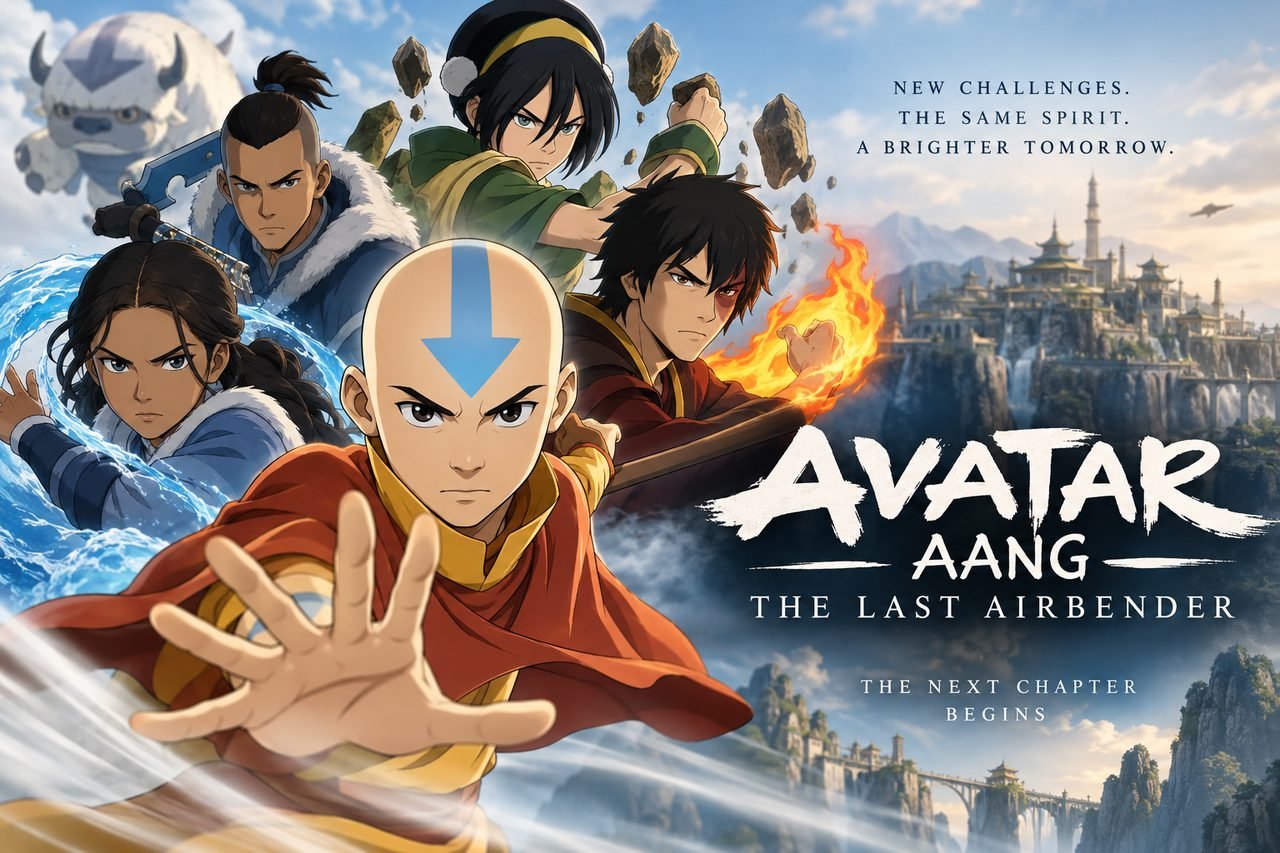
Avatar Aang: The Last Airbender is beautiful, ambitious and clearly made with a lot of respect for the original series. It gives us the characters we already love as young adults and introduces a new problem involving an ancient power that could affect the future of the Air Nomads.
But my biggest problem is also the movie’s biggest weakness.
There simply isn’t enough time.
Seeing Team Avatar Again Is Still Special
Let’s start with the obvious.
Seeing Aang, Katara, Sokka, Zuko and Toph together again feels good.
These characters have been away for a long time, and there is something nostalgic about seeing them interact as adults.
Aang is no longer the twelve-year-old kid we met in the original series.
Katara has grown.
Sokka has grown.
Toph has grown.
Zuko has grown.
Even though they are older, you can still recognize the personalities that made them so memorable.
That was important to me.
The filmmakers didn’t completely reinvent these characters simply because they are older.
Instead, they allow their personalities to mature.
Aang is still optimistic, but he carries much more responsibility.
Katara is more confident.
Sokka still provides humor.
Toph remains Toph.
And Zuko’s presence naturally carries the weight of everything he went through in the original story.
That familiarity is one of the movie’s greatest strengths.
Aang Being an Adult Changes Everything
The most interesting part of the movie for me is seeing Aang as an adult.
In the original series, his biggest challenge was learning how to become the Avatar while still being a child.
Now he has already saved the world.
That creates a completely different problem.
What happens after you accomplish the thing you were told you were destined to do?
Aang has responsibilities.
He has people depending on him.
He has an entire culture that he is trying to preserve.
And he has to deal with the fact that being the Avatar doesn’t mean he can fix everything.
That gives the character a more mature emotional conflict.
The movie is less about becoming the Avatar and more about understanding what being the Avatar actually means.
The Air Nomads Are Still a Big Part of His Identity
The movie’s story is closely connected to Aang’s concern about the survival of his culture.
The official synopsis says Aang discovers an ancient power that could save his culture from extinction, sending him and his friends on a global quest before the power falls into the wrong hands.
I like this direction.
The destruction of the Air Nomads was one of the darkest parts of the original story.
Aang survived, but he didn’t get to save his people.
That loss has always been part of who he is.
So giving him a story about protecting what remains of his culture makes sense.
It isn’t just another random villain-of-the-week adventure.
There is a personal reason for Aang to care.
The Movie Has a More Mature Feeling
One of the things that surprised me is how much older the story feels.
This isn’t the same tone as watching twelve-year-old Aang run around the world trying to master the elements.
The characters are older, and the problems are different.
There is more discussion about responsibility, history, culture and the consequences of past decisions.
That doesn’t mean the movie is dark all the time.
There are still jokes.
Sokka is still funny.
Toph is still brutally honest.
And the chemistry between the characters remains one of the best parts.
But there is a seriousness underneath everything.
That is appropriate.
These characters have grown up.
The movie should grow with them.
The Animation Is Beautiful
If there is one thing I think almost everyone can agree on, it is the animation.
This movie looks fantastic.
The elemental bending is more detailed and cinematic than what we saw in the original television series.
Water moves beautifully.
Fire looks powerful.
Earthbending feels heavy.
Airbending is especially impressive because of how much movement it allows the animators to create.
The environments also look great.
The world feels bigger.
There are large-scale battles, detailed cities and beautiful landscapes that benefit from the feature-film format.
IGN praised the film as “lovingly crafted” and “gorgeously animated,” while RogerEbert.com also highlighted its visual quality.
I agree.
If nothing else, this movie proves that the Avatar world looks fantastic when given a larger animation budget and cinematic presentation.
The Action Is One of the Highlights
The bending fights are another reason to watch.
One of the things that made the original series special was that the fighting wasn’t simply about shooting colorful powers at each other.
The bending styles were connected to martial arts.
That gave the fights personality.
The movie continues that idea.
Aang doesn’t fight like Zuko.
Zuko doesn’t fight like Toph.
Toph doesn’t fight like Katara.
Each character’s abilities still feel distinct.
And because the characters are older, their control over their abilities feels more advanced.
There are several moments where I found myself thinking:
This is exactly why I wanted to see an animated Avatar movie.
But the Story Feels Rushed
This is where my excitement starts to cool down.
The movie runs for about 98 minutes, which is not very long for a story that is trying to continue one of the most detailed fantasy worlds in animation.
There are simply too many ideas.
We have Aang’s relationship with his culture.
We have an ancient power.
We have a new enemy.
We have the return of Team Avatar.
We have new characters.
We have the Spirit World.
We have political consequences.
And we are supposed to care about all of this in less than two hours.
That is a lot.
The result is that some storylines feel like they are moving at double speed.
I wanted certain moments to breathe.
I wanted more conversations between the characters.
I wanted more time with the new characters.
Most importantly, I wanted more time simply watching Team Avatar being Team Avatar.
I Wanted More Sokka
This might be a personal complaint, but I wanted more Sokka.
Sokka was one of the funniest and most useful characters in the original series.
He didn’t have bending abilities, but he constantly proved that intelligence, creativity and leadership could be just as important.
In this movie, the group dynamic is still enjoyable, but I don’t think Sokka gets enough room.
The same applies to some of the other characters.
When you have five beloved characters sharing 98 minutes, someone is going to feel underused.
Toph Is Still Toph
Toph remains one of the easiest characters to enjoy.
She doesn’t suddenly become polite because she is older.
She is still direct.
She is still confident.
She is still willing to tell everyone exactly what she thinks.
And her earthbending remains impressive.
Dionne Quan voices Toph in the movie, alongside Eric Nam as Aang, Jessica Matten as Katara, Román Zaragoza as Sokka and Steven Yeun as Zuko.
The new cast does a good job maintaining the personalities of these characters without simply trying to imitate the original voice performances.
Steven Yeun as Zuko Works for Me
Zuko might be the character I was most interested in hearing as an adult.
His story in the original series was one of the strongest redemption arcs in animation.
Now he is older and has already gone through that journey.
That means the movie doesn’t need to repeat it.
Instead, we get to see what happens after redemption.
Zuko still carries the responsibilities of being Fire Lord, and his relationship with Aang is naturally different from what it was when they were enemies.
I liked that.
Their friendship has history behind it.
They don’t need to explain every part of it.
You can feel that these two people have been through something together.
Dave Bautista’s Character Is Interesting
Dave Bautista voices Tagah, a character connected to the Air Nomads who becomes important to Aang’s journey.
I think Tagah is one of the more interesting additions to the story.
He creates a natural question for Aang.
What does it mean to be an Air Nomad?
Is surviving enough?
Can a culture survive if only a few people remain?
And does Aang have the right to decide what the future of that culture should look like?
Those are interesting questions.
I just wish the movie had more time to develop them.
The Villain Is Not the Strongest Part
This is probably where the movie feels most familiar.
The original series gave us villains with enormous personality.
Zuko.
Azula.
Ozai.
Even characters with smaller roles could leave a strong impression.
The new threat doesn’t reach that level for me.
The conflict works.
The stakes are clear.
But I didn’t feel the same connection to the villain that I felt with the best antagonists from the original show.
The movie seems more interested in Aang’s internal struggle than in creating another unforgettable villain.
That isn’t necessarily a bad thing.
But it means the story’s emotional center is stronger than its villain.
The Spirit World Adds Some Interesting Ideas
I liked the movie’s use of the Spirit World.
The Avatar universe has always treated the Spirit World as something mysterious rather than simply another fantasy location.
The movie continues that tradition.
There are strange creatures, unusual rules and ideas about the relationship between humans and spirits.
Some of the new mythology is fascinating.
However, this is another area where I wanted more explanation.
The film introduces ideas that feel like they could support an entire season of television.
Instead, we get glimpses.
That’s one of my biggest frustrations with the movie.
It keeps showing me things I want more of.
This Should Have Been a Series
This is probably my biggest opinion about the entire movie.
I think this story would have worked better as a television series.
Not because the movie is bad.
Because the world is too big.
Imagine getting eight or ten episodes with this adult version of Team Avatar.
We could see Aang and Katara’s relationship develop.
We could spend more time with Zuko as Fire Lord.
We could see what happened to Sokka.
We could understand Toph’s life.
We could spend more time with the new Air Nomad characters.
We could learn more about the ancient power.
We could spend an entire episode in the Spirit World.
That would have been much more satisfying.
Forbes made a similar argument in its review, suggesting that the story would have benefited from the longer format of a television series.
I completely understand that view.
Still, It Feels Like Avatar
This is important.
Despite my complaints, there is something about this movie that feels right.
It understands the world.
It understands the characters.
It understands that Avatar isn’t simply about bending.
The original series worked because it combined action with humor, friendship, politics, philosophy and emotional storytelling.
The movie doesn’t reach the same level as the original series.
That would be an extremely high bar.
But it does feel like a genuine continuation rather than a cheap attempt to cash in on nostalgia.
That matters.
What I Think Fans Will Like
If you’re already a fan of the original series, there is a lot here for you.
You’ll recognize the characters.
You’ll recognize the world.
You’ll recognize the humor.
You’ll recognize the bending.
And there are plenty of moments that reward people who already understand the history of these characters.
The movie also doesn’t require you to remember every detail from the original show.
It provides enough information for someone unfamiliar with the franchise to understand the basic situation, although longtime fans will obviously get more from it.
The Guardian also noted that the movie is accessible to newcomers while continuing the story for existing fans.
What I Think New Viewers Will Think
If you have never watched the original series, I’m not sure this is the ideal place to begin.
You can follow the basic story.
You understand that Aang is the Avatar.
You understand the four elements.
You understand that the characters are friends.
But the emotional history isn’t the same.
When Zuko and Aang interact, longtime fans understand how far they have come.
A new viewer simply sees two characters who are friends.
That’s a big difference.
So if you haven’t watched the original series, I’d recommend watching it first.
You will appreciate this movie much more.
The Movie’s Biggest Problem Is Also Its Biggest Opportunity
There is something funny about criticizing a movie because I want more of it.
Usually, if a movie is boring, I want it to end.
With Avatar Aang, I wanted it to continue.
I wanted more episodes.
More character development.
More world-building.
More humor.
More Team Avatar.
More of Aang as an adult.
That tells me something.
The movie made me interested in this version of the Avatar universe.
It just didn’t give me enough time inside it.
My Final Take
Avatar Aang: The Last Airbender is a good continuation of a great series, but it feels like the beginning of something much bigger rather than a complete story on its own.
The animation is excellent.
The bending fights are fantastic.
Seeing the original team together again is genuinely satisfying.
Eric Nam gives Aang a believable adult voice, while the rest of the cast does a good job carrying these familiar characters into a new stage of their lives.
The biggest weakness is the runtime.
There is simply too much story packed into 98 minutes.
Some characters needed more time.
Some new ideas needed more explanation.
The villain could have been stronger.
And I desperately wanted more Sokka.
But despite all of that, I enjoyed watching it.
The movie reminded me why this world became so popular in the first place.
It isn’t just about elemental powers.
It’s about people trying to figure out who they are and what responsibility means.
Aang has already saved the world.
Now he has to figure out what comes next.
That is actually a very interesting place to take the character.
The original series showed us Aang becoming the Avatar.
This movie shows us what happens when the Avatar grows up.
And I think there is a lot more story left in that idea.
My rating: 8/10.
Not as good as the original series.
Not even close.
But I don’t think it needs to be.
For me, Avatar Aang: The Last Airbender succeeds because it makes me want more.
More stories.
More adventures.
More time with the Gaang.
And hopefully, if Avatar Studios continues down this path, we eventually get the longer adult-era story these characters deserve.
 James