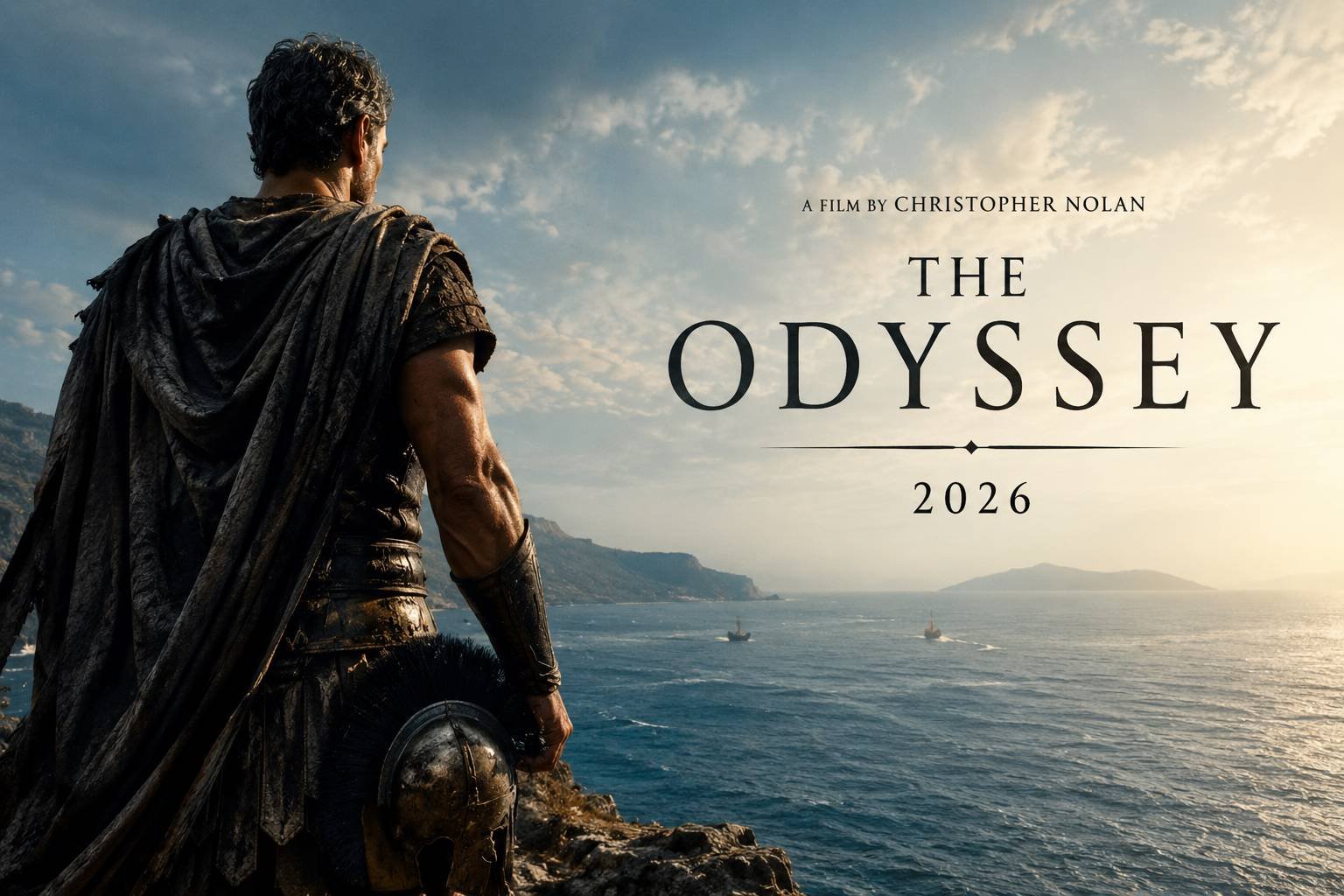
Some movies entertain you for a few hours. Others stay with you long after the credits roll. The Odyssey (2026) feels like the second kind. Even before walking into the theater, I knew this wasn’t going to be a straightforward adaptation of Homer’s epic. Christopher Nolan has never been interested in making ordinary films, and this one continues that tradition.
As I watched, one thought kept coming back to me: this isn’t just a story about a king trying to get home. It’s about time, identity, sacrifice, and what remains of a person after years of war. That idea gives the movie far more emotional weight than I expected.
One thing I appreciated immediately was that Nolan didn’t treat the source material like a museum piece. Instead of making it feel distant or locked in ancient history, he made it feel surprisingly human. The gods, monsters, and mythical locations are still there, but they serve the characters rather than overshadow them.
Matt Damon delivers an Odysseus who feels exhausted in every sense of the word. He’s still brilliant, still calculating, still capable of outsmarting almost anyone, but the years have taken their toll. This isn’t the fearless warrior charging into battle without hesitation. This is a man who has seen enough bloodshed to understand that every victory comes with a cost.
That’s what I enjoyed most.
Too many modern blockbusters make their heroes nearly invincible. Here, Odysseus looks like someone carrying invisible scars. Every decision feels heavier because he understands exactly what failure means. You can see the burden on his face even during the quieter moments.
The visual presentation deserves every compliment it has received. Nolan has always believed that movies should feel larger than life, and this one certainly does. The oceans appear endless, the storms overwhelming, and every kingdom has its own distinct atmosphere. Nothing feels small.
There were several moments where I found myself paying less attention to dialogue simply because I was absorbed by what was happening on screen. That’s usually a sign that the filmmaking is doing its job.
The action sequences never feel like they’re included just to increase excitement. Every confrontation pushes the story forward or reveals something new about the characters. That balance is becoming increasingly rare in blockbuster filmmaking.
Another thing I admired was the pacing.
This isn’t the kind of movie that rushes from one spectacular moment to another. It allows scenes to breathe. Some viewers may think it’s slow, but I never felt bored. Instead, it gave me time to understand what each character was experiencing.
The emotional moments land because the movie earns them.
One aspect I wasn’t expecting was how lonely the journey feels.
Odysseus is surrounded by people for much of the story, yet isolation hangs over nearly every scene. Even when allies are nearby, there’s always the sense that nobody fully understands what he’s carrying. That emotional loneliness became just as important as the physical voyage.
The supporting cast also deserves recognition. Rather than existing only to help the main character, they each bring something meaningful to the story. Every major interaction leaves a lasting impression, whether it’s through wisdom, betrayal, loyalty, or temptation.
The relationship between Odysseus and Penelope remains the emotional center of everything.
Many films would focus almost entirely on battles and mythical creatures, but this adaptation remembers that the destination matters because someone is waiting at the end. Without that emotional anchor, the journey would lose much of its meaning.
One thing that stood out to me was Nolan’s confidence.
He doesn’t feel the need to explain every mystery or spell out every theme. He trusts the audience to connect the dots. That’s something I always appreciate in filmmaking. It makes watching more rewarding because you’re participating instead of simply receiving information.
The musical score plays a huge role in creating that experience.
Rather than constantly demanding attention, it quietly builds tension beneath the surface. During several scenes, I noticed how the music made even simple conversations feel significant. That’s often the sign of a great soundtrack—it works without announcing itself.
The sound design is equally impressive.
The crashing waves, distant thunder, creaking ships, and echoes inside ancient structures all contribute to an atmosphere that feels authentic. Watching it in a premium theater only amplifies that effect.
What surprised me most was how modern the themes feel.
Yes, the story is thousands of years old, but its ideas remain remarkably relevant. Returning home after trauma, struggling to reconnect with loved ones, questioning leadership, resisting temptation, and searching for purpose—these are timeless human experiences.
That explains why The Odyssey continues to be adapted generation after generation.
Great stories don’t survive because they’re old.
They survive because people continue seeing themselves in them.
I also liked that the movie doesn’t pretend its main character is perfect.
Odysseus makes questionable decisions throughout the story. Sometimes his intelligence becomes arrogance. Sometimes his confidence creates unnecessary problems. Those flaws make him believable. Perfect heroes are rarely memorable.
Nolan clearly understands that audiences connect more deeply with imperfect people than flawless legends.
Another strength is restraint.
Many directors would have filled every minute with visual effects. Here, spectacle is balanced with quieter conversations, reflective moments, and emotional pauses. Those quieter scenes give the larger sequences greater impact.
The cinematography is stunning without becoming distracting.
Every frame appears carefully constructed, but it never feels like style exists only for its own sake. Beautiful visuals always support the story rather than competing with it.
One thing I kept thinking throughout the film was how difficult this project must have been.
Adapting one of the most influential stories ever written comes with enormous expectations. Millions already know the basic outline. Everyone has their own image of Odysseus. Finding a fresh perspective without losing what made the original meaningful couldn’t have been easy.
I think Nolan succeeds because he focuses less on mythology and more on humanity.
The monsters matter.
The adventures matter.
The kingdoms matter.
But the emotional journey matters most.
If there is one criticism I understand, it’s that this isn’t designed for viewers expecting nonstop action. The movie asks for patience. It rewards attention. It invites reflection. That’s not everyone’s preferred style, and I can understand why some audiences might struggle with that approach.
Personally, I enjoyed that choice.
Too many modern films seem afraid of silence.
Too many rush toward the next explosion.
Here, the quieter moments often become the most memorable.
By the end, I wasn’t thinking about individual action scenes or visual effects.
I was thinking about endurance.
About what home truly means.
About how people change after everything they’ve survived.
That’s the mark of meaningful storytelling.
A movie doesn’t need to answer every question.
Sometimes it simply needs to leave you thinking.
That’s exactly what this one did for me.
Would I call The Odyssey (2026) a perfect movie?
No.
Very few films deserve that label.
But I do think it’s one of the most ambitious cinematic adaptations of classical literature we’ve seen in years. It respects its ancient roots while giving modern audiences plenty to connect with emotionally.
Christopher Nolan once again proves that large-scale filmmaking doesn’t have to sacrifice intelligence.
It can be visually breathtaking without becoming empty.
It can be emotionally powerful without becoming sentimental.
It can honor an ancient legend while still feeling completely relevant today.
As I left the theater, I realized I hadn’t just watched another historical epic. I had watched a film about resilience, hope, regret, loyalty, and the long road back to the people who matter most.
That’s why I believe The Odyssey (2026) will be remembered long after the box office numbers fade. The visual spectacle will attract audiences, but the emotional journey is what they’ll carry home.
For me, that’s the true victory of this adaptation. It reminded me that every great journey is ultimately about transformation. Odysseus wasn’t simply trying to return to Ithaca. He was trying to find the version of himself that still deserved to call it home.
And that’s a story worth telling in any generation.
 James
James