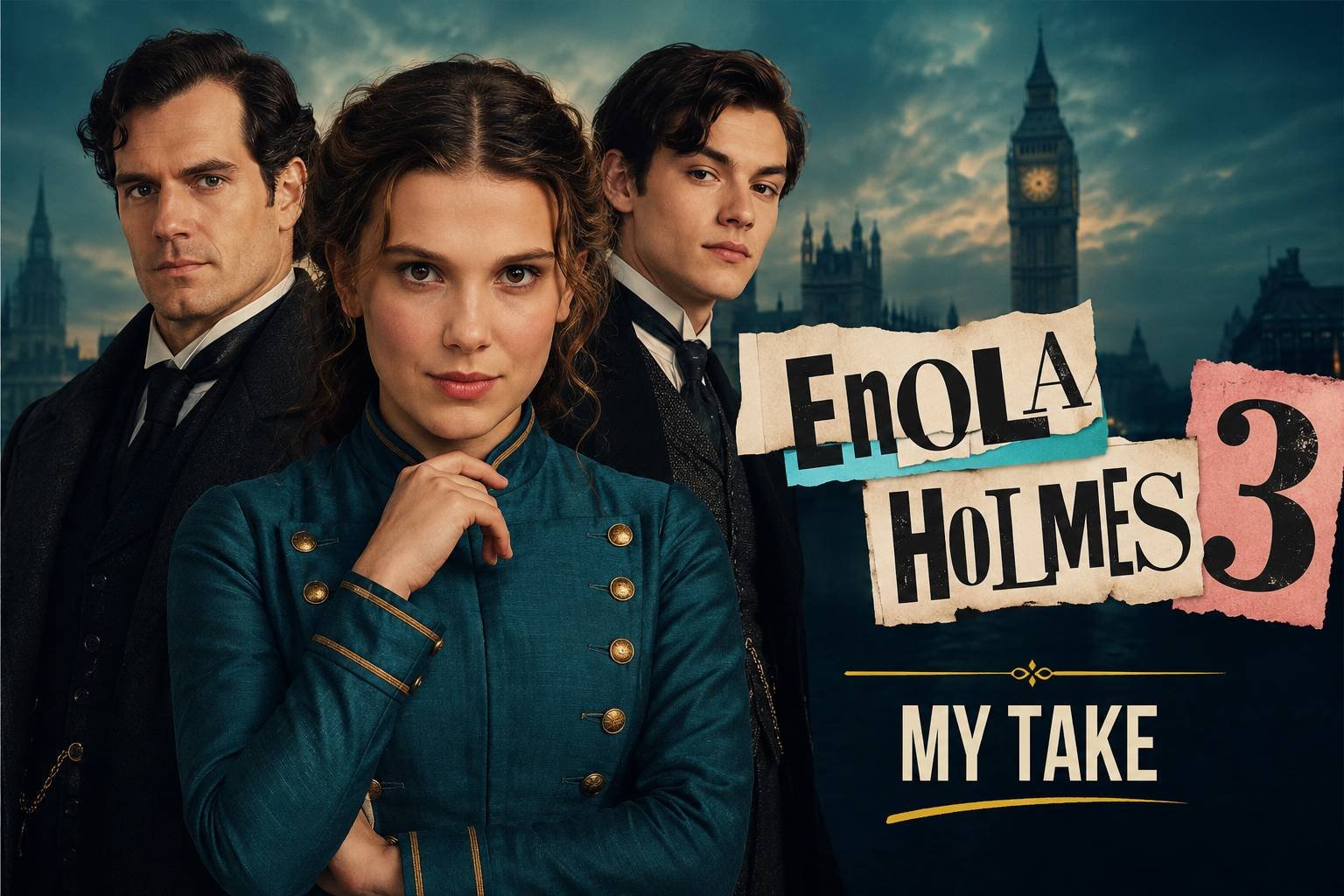
I went into Enola Holmes 3 expecting another fun detective adventure, but I came away feeling like I had watched the most mature film in the trilogy. It still has the humor, clever mysteries, and fourth-wall breaks that made the first two movies enjoyable, but this time the story carries more emotional weight. The stakes feel bigger because the mystery is no longer just about solving a crime. It’s about family, love, trust, and the difficult choices that come with growing up.
From the opening scenes, I had the feeling that this wasn’t going to be another routine investigation. The film wastes very little time before throwing Enola into another dangerous case. Just when it looks like she’s about to begin a new chapter in her personal life, everything changes. That immediate shift kept me interested because it gave the story a sense of urgency that the previous films occasionally lacked.
Millie Bobby Brown once again proves why she is the heart of this franchise. At this point, she doesn’t just play Enola Holmes—she owns the character. Every expression, every sarcastic remark, every moment where she looks directly at the audience feels completely natural. While watching, I never felt like she was forcing the charm. Instead, it feels like spending two hours following a detective who genuinely enjoys solving impossible puzzles.
One thing I appreciated was how much more confident Enola has become. In the earlier films, she often had something to prove. She wanted people to recognize that she was just as intelligent as Sherlock. In this movie, that insecurity is mostly gone. She already knows who she is, and that confidence changes the way she approaches every clue and every confrontation.
The mystery itself is engaging enough to keep you guessing. It isn’t the most complicated detective story ever written, but it constantly gives you enough information to make your own guesses without making the answers too obvious. I caught myself trying to connect different clues throughout the movie, only for the story to reveal another twist that changed my assumptions.
I also enjoyed the new setting. Moving the story away from familiar streets gives the film a fresh look. The scenery feels beautiful without becoming distracting, and it creates opportunities for some exciting chase sequences. There are moments where the locations almost become characters themselves, adding tension simply because of how isolated or dangerous they appear.
Henry Cavill continues to be an excellent Sherlock Holmes. I actually liked that the movie gives him a little more emotional depth this time around. Sherlock has always been portrayed as brilliant but emotionally distant. Here, we get brief moments where his relationship with Enola feels warmer and more believable. You can tell there is genuine respect between them, even if they rarely express it openly.
Their chemistry remains one of my favorite parts of the series. Whenever they share scenes together, it becomes a battle of intelligence rather than ego. Neither tries to overshadow the other. Instead, they complement each other’s strengths, making every conversation entertaining.
Louis Partridge also deserves credit. Tewkesbury has grown considerably since the first movie. He’s no longer simply the young lord Enola has to rescue. He’s more confident, more capable, and far more involved in the story. I liked that he isn’t reduced to being just the romantic interest. He contributes meaningfully to the investigation and stands on his own as a character.
Speaking of the romance, I think the film handles it fairly well. One thing I worried about before watching was whether the relationship would overshadow the detective story. Thankfully, that doesn’t happen. The romance feels like one part of Enola’s life rather than her entire identity. Even when emotions run high, the mystery remains the main attraction.
The action scenes surprised me. I wasn’t expecting anything spectacular, yet several sequences kept me completely engaged. The fights aren’t overly flashy, which actually works in the movie’s favor. They feel grounded enough that every punch and every chase carries real consequences.
Another aspect I appreciated was the pacing. The first half moves quickly, introducing new characters and laying out the central mystery without unnecessary delays. The second half slows down just enough to let important emotional moments breathe before building toward the climax. I never found myself checking how much time was left.
The cinematography is another improvement. There are several beautifully framed shots that make the movie look more cinematic than the previous entries. Whether it’s the coastal landscapes, narrow streets, or candlelit interiors, the visuals consistently look polished.
The costume design also deserves recognition. Every outfit fits the period while still giving each character a unique identity. Enola’s wardrobe especially reflects her personality—practical when solving mysteries but elegant when the situation demands it. Small details like these help make the world feel authentic.
One thing that stood out while I was watching was how much darker the story becomes at times. The movie isn’t afraid to place beloved characters in genuine danger. There were moments when I honestly wondered how certain situations would be resolved. That uncertainty made the experience more exciting because I never felt like everyone was automatically safe.
The villain is another improvement, although not a perfect one. Their motivations make sense within the story, but I felt there were moments where the character could have been developed even further. A memorable detective film often depends on having an equally memorable antagonist. While this villain certainly creates problems for Enola, I wanted just a little more depth.
That said, the confrontation between hero and villain works well. It isn’t simply about physical strength. It’s a battle of intelligence, manipulation, and strategy, which fits perfectly within the Holmes universe.
I also appreciated that the screenplay trusts the audience. It doesn’t overexplain every clue immediately. Instead, it allows viewers to piece things together alongside Enola. As someone who enjoys mystery films, I always appreciate when writers resist the temptation to spoon-feed every answer.
The humor remains one of the franchise’s strongest qualities. It never turns into full comedy, but there are enough clever one-liners and awkward situations to keep the mood light even during tense moments. Several conversations made me smile simply because of how naturally the jokes fit into the dialogue.
Millie Bobby Brown’s direct conversations with the audience continue to work surprisingly well. Breaking the fourth wall can sometimes become distracting, but here it feels like part of Enola’s personality. It’s almost as though she’s inviting us to become her detective partner instead of merely watching from the sidelines.
Emotionally, I think this is where Enola Holmes 3 succeeds the most. Beyond solving crimes, the story asks what kind of life Enola truly wants. Can she balance independence with love? Can she remain true to herself while embracing change? Those questions give the film more depth than I expected.
There were a few scenes that genuinely made me pause because they highlighted how much Enola has matured since the first movie. She’s still adventurous and impulsive, but she’s also learning that every decision affects the people she cares about.
Not everything works perfectly, though. There are moments where the story relies a little too much on coincidence. A few important clues seem to appear at exactly the right moment, making parts of the investigation feel slightly convenient. While it didn’t ruin the experience for me, I did notice it.
I also think some supporting characters deserved more screen time. A few interesting personalities appear briefly before disappearing for long stretches. I would have liked the movie to spend more time developing them because they had plenty of potential.
The ending is satisfying without feeling overly predictable. It wraps up the central mystery while leaving enough room for future adventures. I appreciated that the resolution focused on character growth rather than simply celebrating another solved case.
As the credits rolled, I found myself comparing the three films. For me, Enola Holmes 3 sits comfortably alongside the best moments of the franchise. The first movie introduced us to a refreshing new detective. The second expanded her world. The third finally feels like the point where Enola becomes fully comfortable standing beside Sherlock rather than beneath his shadow.
If I had to rate the performances, Millie Bobby Brown is easily the standout. Henry Cavill continues to deliver a version of Sherlock that’s calm, intelligent, and quietly charismatic. Louis Partridge brings more confidence than ever before, while Helena Bonham Carter once again adds energy whenever she appears.
Would I watch it again? Absolutely. Not because it’s a flawless mystery, but because it’s entertaining from beginning to end. It balances action, comedy, suspense, and heartfelt moments without losing sight of what made the series popular in the first place.
My final verdict is that Enola Holmes 3 is a worthy continuation of the franchise. It raises the emotional stakes, gives its characters meaningful development, delivers an engaging mystery, and reminds us why Enola Holmes has become one of Netflix’s most enjoyable modern detective characters. While it has a few pacing issues and some underdeveloped supporting roles, those shortcomings are outweighed by strong performances, beautiful visuals, and a story that kept me invested until the final scene.
If you enjoyed the first two films, I think you’ll have a great time with this one. And if this truly isn’t the end of Enola Holmes’ journey, I’d happily return for another mystery. After watching this film, it feels like the franchise still has plenty of stories left to tell.
 James
James