There is something particularly unsettling about a horror movie that does not rush to show you the monster.
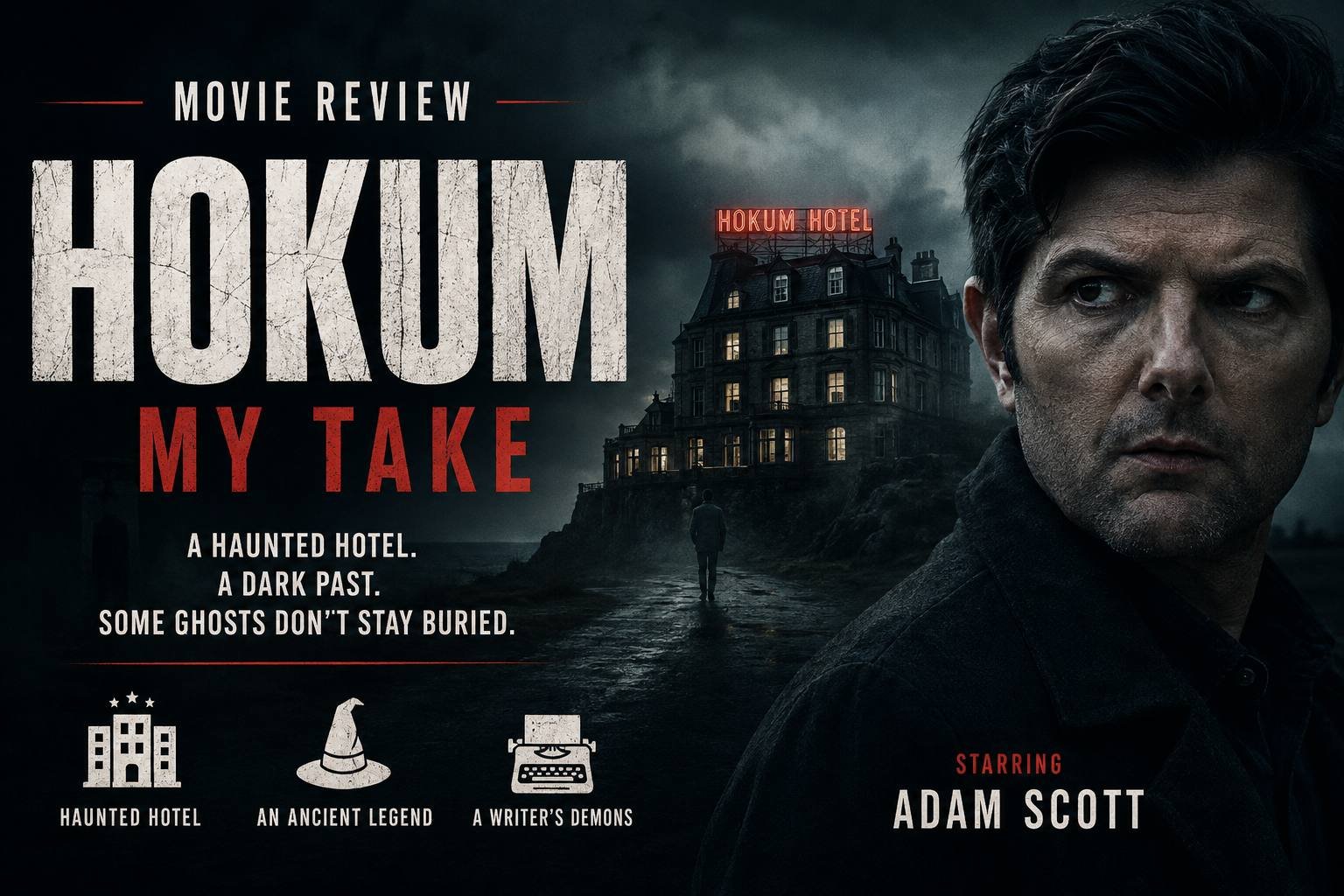
Hokum, directed by Damian McCarthy and starring Adam Scott, takes that approach for much of its runtime. Instead of relying entirely on loud jump scares and obvious supernatural creatures, the movie builds its horror around an isolated Irish hotel, a strange legend, a missing woman, and a troubled writer who appears to be carrying more ghosts inside him than the building itself.
For me, Hokum is one of those horror movies that works better because of its atmosphere than because of its story. It is creepy, strange and beautifully shot, but it also has moments where the story becomes unnecessarily complicated.
And that is probably the best way to describe my experience with the movie: I liked it, I was uncomfortable watching it, and I still had questions when it ended.
What Is Hokum About?
The movie follows Ohm Bauman, played by Adam Scott, a successful but deeply unpleasant horror novelist who travels from America to a remote part of Ireland.
His reason for going there is personal. His parents spent their honeymoon at the hotel many years earlier, and after their deaths, Ohm travels there to scatter their ashes near a place associated with happier memories of his mother and father.
But the hotel is not exactly a peaceful destination.
There are stories about a witch connected to the hotel’s sealed honeymoon suite. The room has been closed off, and the locals clearly do not want anyone going near it.
Then a hotel employee named Fiona disappears.
Naturally, Ohm becomes increasingly interested in what happened to her, particularly when suspicion turns toward the forbidden honeymoon suite.
And this is where the movie really begins to descend into madness.
Adam Scott Is Surprisingly Good
One of the biggest reasons Hokum works is Adam Scott.
Most people probably know Scott from his comedy and television work, so seeing him play such a miserable, alcoholic and emotionally damaged character is quite interesting.
Ohm is not the typical horror protagonist you immediately want to support.
He’s rude.
He’s arrogant.
He’s difficult.
He’s not particularly interested in other people’s opinions, and he seems to carry a considerable amount of anger inside him.
That makes his journey more interesting because the movie does not present him as some perfect hero who accidentally finds himself in a haunted hotel.
Instead, Ohm is already broken before the supernatural elements become serious.
His problems with his parents, his alcoholism, his career and his own personality are all part of the horror. The hotel almost feels like a physical manifestation of everything he has been trying to avoid.
That’s something I appreciated.
The movie is not simply saying, “Man enters haunted hotel.”
It’s closer to “A damaged man enters a haunted hotel, and the place forces him to confront everything he has been running from.”
That gives the movie more substance than a standard haunted-house story.
The Hotel Is the Real Star
If I had to pick one element that makes Hokum memorable, it would be the setting.
The hotel is creepy without looking like the usual abandoned haunted house.
There are dark corridors, strange rooms, uncomfortable spaces and areas that make you feel like something could be standing just outside the frame.
The cinematography by Colm Hogan does a lot of the heavy lifting. The movie uses darkness, shadows and negative space effectively, often making you look at an empty part of the screen and wonder whether something is actually there.
That is exactly the kind of horror I enjoy.
You don’t always need a monster jumping into the camera.
Sometimes, an empty hallway is enough.
Sometimes, hearing a sound from another room is enough.
Sometimes, the fact that a door is slightly open is enough.
Hokum understands that fear often comes from what your brain thinks might be there.
It Has Some Properly Creepy Moments
I won’t spoil the major scares, but there are several moments in Hokum that genuinely got under my skin.
The film uses jump scares, but it does not depend entirely on them. Several critics also highlighted the movie’s atmosphere and ability to create tension through darkness, sound and carefully controlled framing.
That distinction matters.
A cheap jump scare can make you jump for two seconds and then disappear from your mind.
The better moments in Hokum stay with you because they create a feeling that something is wrong.
The movie also has some disturbing imagery that I think horror fans will appreciate.
There are moments when you are not entirely sure whether you should be laughing, feeling disgusted or preparing yourself for something horrible.
That strange mixture is part of the movie’s identity.
But the Story Gets Messy
This is where my opinion becomes more complicated.
I enjoyed the atmosphere more than I enjoyed the actual storytelling.
Hokum throws a lot at the audience.
There is a haunted hotel.
A witch.
A missing woman.
A troubled writer.
Family trauma.
Alcoholism.
Folk horror.
Strange locals.
Unusual creatures and imagery.
Psychological horror.
And several mysteries that the film expects you to piece together.
Some critics praised the movie’s ambiguity, while others felt that its collection of mysteries and backstories made the narrative unnecessarily messy.
I’m somewhere in the middle.
I don’t mind movies leaving certain things unexplained. In fact, horror can become less frightening when everything is explained.
But there were moments during Hokum when I felt the movie was deliberately withholding information simply because it wanted to remain mysterious.
There is a difference between mystery and confusion.
A good mystery makes you think.
Confusion makes you wonder whether you missed something.
At times, Hokum gives you both.
The Horror Has More Going On Than It First Appears
What I think makes the movie interesting is the way its supernatural story connects with Ohm’s personal problems.
The horror is not just about a witch.
It is also about grief, guilt, regret and the consequences of carrying unresolved pain.
Ohm has spent years dealing with the death of his parents and the complicated memories surrounding them. His trip to Ireland is supposed to give him some form of closure.
Instead, he walks into something much darker.
The hotel becomes a place where the past refuses to stay buried.
That theme is familiar in horror, but McCarthy gives it enough personality to keep it interesting.
The film’s folk-horror influences also give it a distinct identity. Rather than simply copying American haunted-house movies, Hokum uses Irish folklore and the isolated rural setting to create something more unusual.
Is It Like The Shining?
There are obvious comparisons.
A writer.
An isolated hotel.
A deteriorating mental state.
Something supernatural waiting inside.
So yes, if you have seen The Shining, you may notice some similarities.
But I wouldn’t call Hokum a copy.
The movie has its own strange personality, particularly because of McCarthy’s interest in folklore, bizarre imagery and uncomfortable characters.
There are also traces of other horror influences, but Hokum ultimately feels like its own movie.
And honestly, that is a good thing.
My Biggest Problem With Hokum
My biggest problem is that I sometimes felt the movie was trying too hard to be mysterious.
There are films where you finish watching and immediately want to discuss what happened.
Then there are films where you finish watching and think:
“Wait… what exactly happened?”
Hokum occasionally falls into the second category.
That does not necessarily make it bad.
In fact, some people will probably love that aspect of it.
But personally, I wanted a little more clarity toward the end.
The movie is already creepy enough. It doesn’t need to hide every answer behind another mystery.
Still, the ambiguity is clearly intentional, and several critics saw that uncertainty as part of McCarthy’s approach to horror.
My Verdict
Hokum is not perfect, but I think it is worth watching if you enjoy atmospheric horror.
If you want a horror movie that constantly throws monsters at you, this might not be the movie for you.
But if you like haunted locations, folklore, psychological horror, strange characters and stories that leave you thinking after the credits, Hokum has plenty to offer.
Adam Scott gives the movie a strong central performance, and Damian McCarthy demonstrates why he has become an interesting name in modern horror following films such as Caveat and Oddity. Critics have generally responded positively to the movie, with Metacritic listing it in the generally favorable range.
For me, the movie’s biggest strength is its atmosphere.
The hotel feels wrong.
The darkness feels dangerous.
The silence feels suspicious.
And sometimes you are simply waiting for something terrible to appear.
My biggest complaint is the story. There are moments when Hokum becomes more complicated than it needs to be, and not every mystery lands as effectively as the filmmakers probably intended.
But overall?
I enjoyed it.
It is creepy, beautifully constructed and strange enough to stand out from the endless stream of generic horror movies.
My Rating: 7.5/10
Hokum is a good horror movie with a great atmosphere, a strong performance from Adam Scott and some genuinely unsettling moments. It doesn’t always stick the landing, but the journey into that haunted hotel is definitely worth taking.
If you like horror that makes you uncomfortable rather than simply making you scream, Hokum deserves a spot on your watchlist.
 James
James