There are some movies you watch because the story sounds interesting. Then there are movies you watch because you want to know what everyone is talking about.
For me, The Housemaid falls somewhere in between.
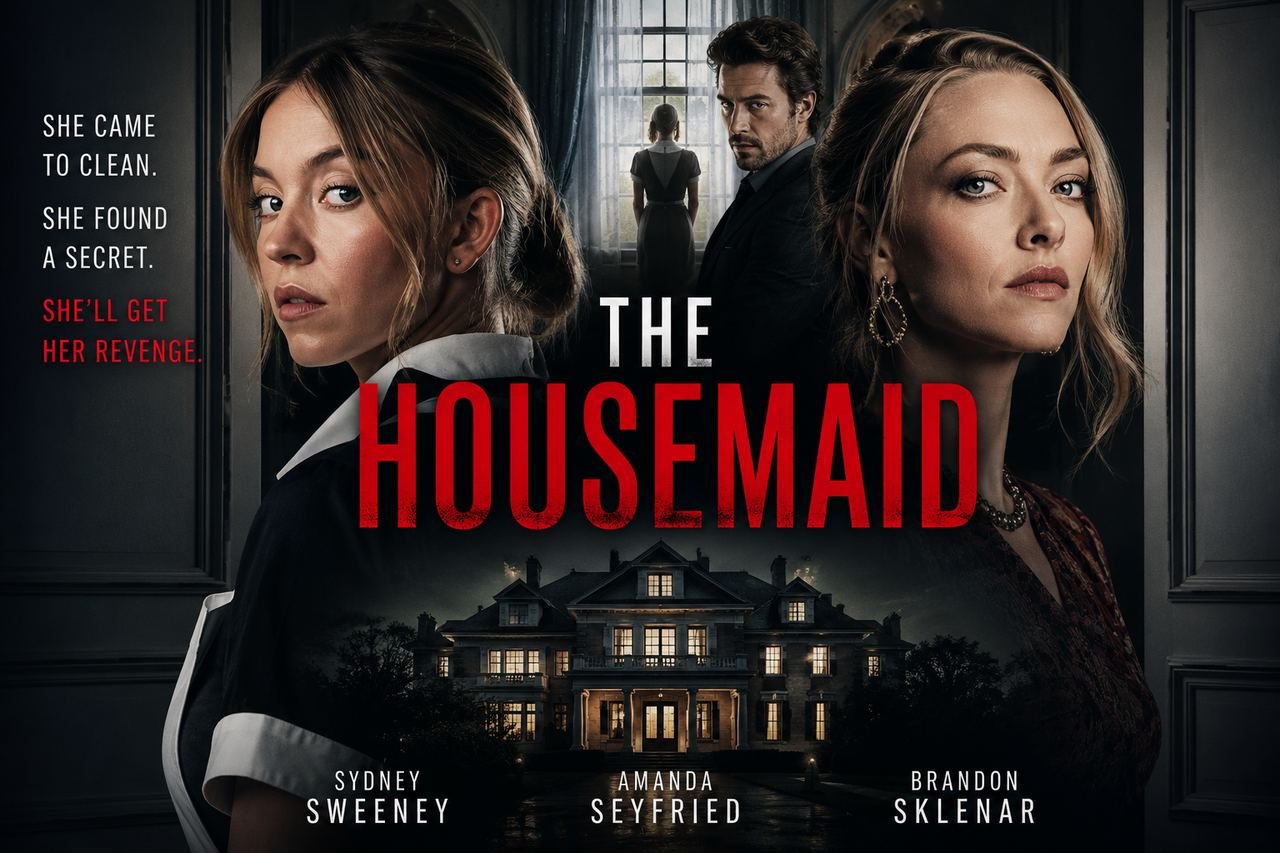
Directed by Paul Feig and starring Sydney Sweeney, Amanda Seyfried and Brandon Sklenar, the 2025 thriller is based on Freida McFadden’s bestselling novel. It follows Millie Calloway, a young woman with a troubled past who desperately needs a fresh start. When she gets a live-in housemaid job with the wealthy Winchester family, it looks like the opportunity she has been waiting for.
Of course, nothing about the Winchester household is normal.
What begins as a simple job quickly turns into a disturbing game involving manipulation, attraction, secrets, abuse and revenge. And just when you think you understand what is happening, the movie changes the story again.
My take? The Housemaid is messy, dramatic and sometimes ridiculous but it is also extremely watchable.
And that is probably its biggest strength.
The Movie Knows Exactly What Kind of Thriller It Wants to Be
The first thing I noticed about The Housemaid is that it does not try to be a serious, realistic psychological drama.
It is much closer to those dramatic thrillers where everyone has secrets, nobody is exactly what they appear to be, and the situation becomes more unbelievable with every major reveal.
That is not necessarily a bad thing.
In fact, I think the movie is better when you accept that from the beginning.
The story is deliberately exaggerated. The wealthy house is almost too perfect. The characters can be extremely dramatic. The relationships become increasingly complicated. And the movie keeps giving you reasons to question what you have already seen.
Some viewers may find that ridiculous.
I found it entertaining.
Sydney Sweeney as Millie
Sydney Sweeney plays Millie, a woman who is trying to rebuild her life after spending years in prison.
That immediately makes her an interesting character because she is not entering the Winchester home as someone with a completely clean past.
She needs the job.
She needs somewhere to live.
And she needs to stay out of trouble.
That puts her in a vulnerable position from the beginning.
What I liked about Millie is that the movie doesn’t make her completely helpless. She may be walking into a dangerous situation, but she is observant. She notices things. She questions what she sees.
Sweeney also does a good job of making Millie sympathetic without making her feel completely innocent.
There are moments when you start wondering whether she has her own agenda.
And that uncertainty is important because the movie wants you to keep changing your opinion about her.
I do think the performance becomes stronger toward the end.
The first part of the movie sometimes makes Sweeney feel restrained while Amanda Seyfried is giving the audience much more to react to. Even RogerEbert.com’s review made a similar observation, arguing that Seyfried dominates much of the early film before Sweeney becomes more engaging during the final stretch.
For me, that shift works because it mirrors the story itself.
Millie starts as someone who appears to have very little control.
By the end, that changes.
Amanda Seyfried Steals the Movie
If I had to pick the performance that stayed with me the most, it would be Amanda Seyfried.
Her character, Nina Winchester, is supposed to make you uncomfortable.
And she does.
At first, Nina appears to be the unstable wife in a wealthy household. She is unpredictable, emotional and constantly creating problems for Millie.
You start thinking that you understand the situation.
Then the movie starts pulling the rug out from under you.
Seyfried plays Nina with a strange combination of elegance and chaos. She can look perfectly composed in one moment and completely out of control in the next.
That contrast makes her fascinating.
Several critics singled out her performance as one of the movie’s biggest strengths. Variety described Seyfried’s performance as startling, while Rotten Tomatoes’ critics consensus also highlighted her unsettling presence.
I completely agree.
Even when the story becomes excessive, Seyfried makes you want to see what Nina will do next.
Brandon Sklenar’s Andrew Is a Different Story
Then we have Andrew.
At first, he seems like the reasonable person in the house.
He is calm.
He is attractive.
He appears to understand Millie’s situation.
And compared with Nina’s behavior, he looks almost perfect.
That is exactly why the character works as part of the setup.
The movie wants you to trust him.
And I think most viewers will understand fairly quickly that they probably shouldn’t.
Brandon Sklenar plays Andrew as charming and controlled, but I did find the character less interesting than Millie and Nina.
That may be intentional.
Andrew is supposed to be the person who initially makes the audience question whether Nina is really the problem.
But once the movie starts revealing more about him, the character becomes much more disturbing.
The Biggest Strength Is the Twists
If you are going into The Housemaid hoping for a straightforward story, you may be disappointed.
If you enjoy movies that keep changing your understanding of the characters, you will probably have a much better time.
The movie repeatedly gives you one version of the situation and then asks you to reconsider it.
At first, you think Nina is the problem.
Then you start questioning Andrew.
Then you start questioning Millie.
Then you realise things are happening behind the scenes that you didn’t understand.
That structure is the reason I would recommend avoiding major spoilers before watching it.
The less you know, the better.
Even the official synopsis emphasises that the story is built around secrets, scandal, power and unexpected developments.
But the Movie Is Not Perfect
Now, this is where my take becomes a little more critical.
The Housemaid is entertaining, but I wouldn’t call it a perfect thriller.
The biggest problem for me is the pacing.
The movie runs for about two hours and eleven minutes, and there are moments when it feels like the story is taking too long to get to its next major development.
Some scenes feel like they exist mainly to remind us that something strange is happening.
There are also moments when the dialogue is a little too obvious.
You can sometimes see where the movie is going before the characters get there.
And some of the plot developments require you to stop asking too many questions.
Variety made a similar point, noting that the movie’s heightened style makes some of its contrivances easier to accept.
I think that is the right way to watch it.
Don’t treat every event like it needs to pass a real-life logic test.
Just go with the movie.
The House Is Almost a Character
One thing I really liked is the way the Winchester home is used.
It looks beautiful.
It is expensive.
It is clean and carefully designed.
But there is something uncomfortable about it.
The house is supposed to represent wealth and security, yet it slowly becomes a place of fear.
Millie’s room is particularly important.
At first, getting a room in such a beautiful house looks like a huge upgrade from the life she has been living.
But the same room eventually becomes part of the movie’s darker side.
That contrast is effective.
The message is simple: a beautiful house does not necessarily mean a beautiful life.
It Also Says Something About Wealth and Power
Under all the drama, the movie has another interesting idea.
Millie is desperate for work.
The Winchesters have money.
That difference gives them power over her.
She has very little room to make mistakes because losing the job could mean losing her home and putting her future at risk.
That makes some of the early scenes more uncomfortable.
Millie isn’t simply dealing with a difficult employer.
She is trapped in a situation where she needs the people who are making her life difficult.
The movie uses that imbalance to build tension.
It also makes the later changes in the power dynamic more satisfying.
The Final Act Is Where Things Get Wild
Without giving away every detail, the final part of the movie is where The Housemaid fully commits to its thriller identity.
The story becomes more violent.
The characters become more desperate.
The secrets come out.
And the relationship between Millie and Nina changes dramatically.
This is also where the movie becomes more entertaining for me.
Some of the earlier scenes are spent making you wonder who is telling the truth.
The final act finally starts giving you answers.
There are still moments where I thought, “Come on, this is a little too much.”
But at the same time, I was still watching.
And that says something.
A thriller doesn’t necessarily have to be perfectly realistic to be enjoyable.
Sometimes you just want to see how crazy the situation is going to become.
My Favorite Thing About the Movie
My favorite thing about The Housemaid is probably the way it keeps changing your opinion of the characters.
You begin with a simple assumption.
Poor woman gets a job with a rich family.
The wife is unstable.
The husband seems kind.
The housemaid is the outsider.
Then the movie starts changing those roles.
That is what makes the story fun.
The film is basically asking:
Who is really trapped here?
And the answer keeps changing.
Would I Recommend It?
Yes.
But I would recommend it for the right reason.
Don’t watch The Housemaid expecting a perfectly realistic psychological thriller.
Watch it if you enjoy dramatic, twist-heavy movies where relationships become increasingly toxic and the story keeps throwing new information at you.
It is stylish.
It has strong performances.
Amanda Seyfried is particularly good.
Sydney Sweeney becomes much more interesting as the story progresses.
And the final stretch delivers the kind of chaotic thriller energy that keeps you watching.
The movie has already divided critics somewhat, with Rotten Tomatoes currently showing a 74% critics score and a much stronger 92% audience score, which tells you something about its appeal: audiences seem to be having more fun with it than some critics.
I understand both sides.
There are definitely things I would have changed.
I would have tightened the middle.
I would have made some character decisions more believable.
And I wouldn’t have minded if the movie leaned even further into its dark, campy side.
But despite those complaints, I had fun watching it.
My Final Verdict
The Housemaid is not a perfect movie, but it is a very entertaining one.
The story is full of twists, the performances keep things moving, and the movie understands that its biggest attraction is making the audience question what is really happening inside that beautiful house.
Amanda Seyfried is the standout for me, while Sydney Sweeney becomes increasingly impressive as Millie’s situation changes.
The biggest mistake you can make is reading too many spoilers before watching it.
Go in knowing only the basic setup.
A woman needs a job.
A wealthy family needs help.
And something is very wrong inside the house.
That’s enough.
For me, The Housemaid is one of those movies where the question isn’t whether every part of the story makes perfect sense.
The question is whether you will want to keep watching.
I did.
And if you enjoy twisty domestic thrillers with secrets, manipulation, power games and a little bit of madness, I think you probably will too.

 James
James