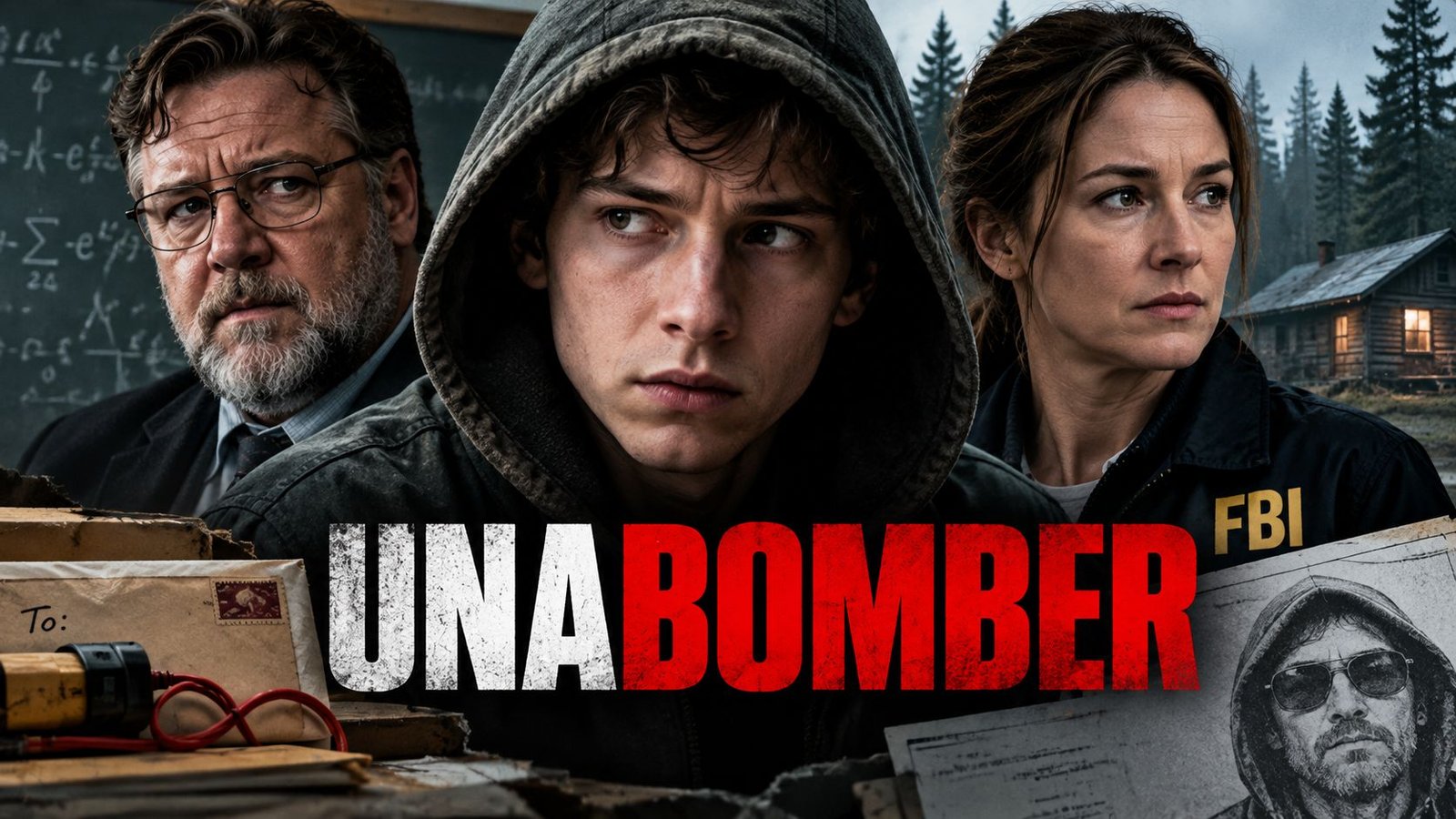
What happens when someone with an extraordinary mind becomes completely disconnected from the world around him?
Does intelligence make a person better at understanding life, or can it sometimes make them feel even more isolated? And how much of a person’s future is shaped by their childhood, their environment, and the people who influence them?
These are some of the disturbing questions raised by Unabomber (2026), a crime drama based on the life of Ted Kaczynski, the man who terrorised America with a series of mail bombs over nearly two decades.
Directed by Janus Metz, the Netflix film stars Jacob Tremblay as the young Ted Kaczynski, Russell Crowe as Harvard professor Henry Murray, and Shailene Woodley as FBI agent Joanne Miller.
Rather than focusing exclusively on the manhunt, the film attempts to show how Kaczynski’s early experiences, psychological struggles, and growing resentment became part of the story behind his later crimes. It moves between his years as a young academic and the investigation that eventually brings the FBI closer to identifying him.
The subject is fascinating, but it is also disturbing. This is the story of a man whose intelligence did not prevent him from causing terrible suffering to innocent people.
The big question is whether Unabomber manages to turn this real-life tragedy into a compelling psychological thriller or whether it struggles to explain a complicated story.
What Is Unabomber About?
Unabomber tells the story of Ted Kaczynski, a brilliant young mathematician whose life takes a dark turn after his time at Harvard.
As a teenager, Kaczynski demonstrates exceptional intellectual ability. He enters Harvard at a young age and appears to have the academic potential to build an extraordinary future.
But being academically gifted does not mean that someone is emotionally prepared for everything life throws at them.
During his time at Harvard, Kaczynski participates in controversial psychological experiments conducted under Professor Henry Murray, played by Russell Crowe. The film presents these experiences as part of the disturbing history that shapes his later outlook.
As the story progresses, the narrative shifts to the 1990s, when FBI agent Joanne Miller, played by Shailene Woodley, is involved in the investigation into the Unabomber.
For years, the bomber has sent explosive packages to various targets, killing and injuring people while leaving investigators struggling to identify him.
The attacks create fear and uncertainty. Sending or opening an ordinary package becomes a potentially terrifying experience because nobody knows whether it might contain a bomb.
Miller becomes increasingly interested in understanding the person behind the attacks. Rather than accepting every assumption about the suspect, she questions existing theories and tries to identify the clues that might reveal his identity.
The film moves between these two periods, connecting Kaczynski’s earlier experiences with the investigation that eventually exposes him.
One storyline examines the making of a dangerous individual. The other follows the people trying to stop him.
It is an ambitious approach because it asks viewers to consider both the psychology of the offender and the devastating consequences of his actions.
Jacob Tremblay’s Performance as Ted Kaczynski
One of the most important elements of Unabomber is Jacob Tremblay’s performance.
Playing a real person associated with horrific crimes is not an easy task. The actor has to portray the character convincingly without turning him into a cartoon villain or making his behaviour seem more understandable than it actually is.
Tremblay approaches young Kaczynski as an intelligent but increasingly troubled individual.
His performance focuses on the character’s discomfort, social isolation, and growing resentment. Instead of presenting Kaczynski as someone who was always destined to become a terrorist, the film attempts to show the development of a person whose thinking becomes increasingly destructive.
This makes the character more complicated to watch.
You can recognise his intelligence without admiring his choices. You can consider the experiences that influenced him without excusing the violence he later committed.
That distinction matters.
One of the dangers of true-crime storytelling is that it can become so fascinated by the criminal that the victims are pushed into the background. When a story focuses on a notorious offender’s intelligence, childhood, or unusual personality, audiences may begin to see the individual as more interesting than the human consequences of his actions.
Tremblay’s performance gives the film a psychological centre, although the story’s attempt to explain Kaczynski’s development is not always as convincing as it wants to be.
The character’s transformation is unsettling, but understanding how someone becomes dangerous is not the same as identifying one simple reason for everything they eventually do.
Russell Crowe Brings Weight to the Story
Russell Crowe plays Professor Henry Murray, the Harvard academic whose controversial experiments form an important part of the film’s examination of Kaczynski’s past.
Crowe brings authority to the role. His character represents the academic world, where people study the human mind and attempt to understand behaviour.
But the film also raises uncomfortable questions about power and responsibility.
What happens when an authority figure uses their position in ways that leave another person psychologically vulnerable? What responsibility do institutions have for the treatment of the people who participate in their experiments?
These are difficult questions, especially when the story concerns a young student surrounded by people who possess considerably more power and influence than he does.
Crowe’s performance helps make those scenes engaging. He does not need to turn every moment into a dramatic confrontation to create tension.
However, the movie sometimes leans too heavily on the idea that Kaczynski’s early experiences provide the key to understanding everything that follows.
Human behaviour is rarely that simple. Psychological harm, social isolation, ideology, personal decisions, and other circumstances can interact in complicated ways.
Even when a person’s past helps explain their behaviour, it does not remove their responsibility for deliberately hurting others.
That is a distinction the film needs to maintain.
Shailene Woodley and the FBI Investigation
While Tremblay and Crowe anchor the psychological side of the story, Shailene Woodley’s Joanne Miller gives the film its investigative dimension.
Miller is not simply interested in finding a suspect. She wants to understand how the person behind the attacks thinks.
The FBI has to examine evidence, study patterns, and decide which theories are worth pursuing. Every mistaken assumption can send investigators in the wrong direction.
This part of the story has the potential to deliver a tense crime thriller.
The audience knows that Kaczynski is the person the investigation is trying to identify, but the investigators must work through uncertainty. Their challenge is to turn scattered clues into a coherent picture of the offender.
Unfortunately, the film’s two timelines do not always work together as effectively as they could.
The transitions between Kaczynski’s past and the FBI investigation sometimes make the story feel fragmented. Instead of allowing the suspense to build naturally, the film occasionally interrupts one storyline to return to the other.
Woodley brings determination to Miller, but the character is not always given enough depth to make her side of the story as compelling as it should be.
The investigation sometimes feels like a framework for connecting the film’s psychological scenes rather than a fully developed drama in its own right.
That is disappointing because the search for the Unabomber was an extraordinary investigation, involving years of painstaking work and the eventual identification of a suspect whose writings helped expose him.
The Film’s Biggest Problem: Explaining Too Much With Too Little
This is where Unabomber becomes more complicated.
The film wants to answer a fascinating question: how did a brilliant young man become a domestic terrorist?
It is a reasonable question, and the story has several important elements to examine. Kaczynski’s academic experiences, his isolation, his hostility towards modern society, and his ideological beliefs all matter to the broader story.
But there is a difference between examining these factors and suggesting that they form a straightforward explanation for his crimes.
The movie’s focus on his early experiences risks making his transformation appear more neatly explained than real life allows.
A difficult childhood does not automatically create a violent adult. Intelligence does not inevitably produce alienation. Disagreement with society does not inevitably lead to terrorism.
Millions of people experience rejection, frustration, loneliness, and disappointment without choosing to harm others.
Kaczynski’s story is disturbing partly because his eventual actions involved decisions that went far beyond private frustration or unconventional beliefs.
The film could have done more to examine the distance between his philosophical objections to modern society and his decision to use violence against people who were not responsible for his personal struggles.
That distinction is essential if the story is going to offer meaningful insight rather than simply a dramatic explanation for a notorious criminal.
The Victims Deserve More Attention
Another weakness is the balance between the offender’s psychological story and the suffering caused by his crimes.
Kaczynski’s bombing campaign killed three people and injured many others. His actions also created fear for people who had no way of knowing whether a package was safe.
These were not merely plot points in an elaborate mystery. They were real events that changed real lives.
A film about a notorious criminal does not have to devote every scene to the victims, but it should be careful not to make their suffering feel like background material for the offender’s personal journey.
The movie’s opening sequence uses the threat of a bomb to create suspense, but that approach can feel uncomfortable when the victim’s experience is primarily used to build tension.
The audience is encouraged to anticipate the violence, yet the story does not always give the people affected enough space to exist as individuals rather than symbols of the criminal’s actions.
This is one of the broader challenges of true-crime entertainment.
The person responsible for the crimes often receives the most attention because their motives are mysterious and their behaviour is unusual. The victims, meanwhile, can become secondary characters in a story that is supposedly about them as well.
I would have liked Unabomber to spend more time showing the human consequences of Kaczynski’s actions and less time relying on his psychology to carry the entire narrative.
Is Unabomber Worth Watching?
Despite its weaknesses, Unabomber has a subject that naturally attracts attention.
The contrast between Kaczynski’s academic brilliance and his eventual crimes is disturbing. The controversial psychological experiments add another uncomfortable dimension, while the FBI investigation provides opportunities for suspense.
The performances from Tremblay and Crowe also give the film moments of genuine intensity.
However, the movie struggles to turn these ingredients into a consistently effective thriller.
The storytelling can feel uneven, and the film’s psychological arguments are not always developed deeply enough. Rather than allowing viewers to wrestle with the complexity of Kaczynski’s transformation, the narrative sometimes appears too eager to connect his past experiences to his later behaviour.
Critics were largely unimpressed. RogerEbert.com criticised the film’s familiar biographical approach and its treatment of the victims, while Rotten Tomatoes’ critics’ consensus similarly questioned whether the performances could compensate for the film’s central argument. <Cite refs={[“turn803886search6″,”turn803886search0”]}/>
That does not mean the movie has nothing to offer. Viewers interested in real criminal investigations, psychological dramas, or the history behind notorious cases may still find it worth watching.
But anyone expecting a tightly constructed thriller with a deeply nuanced examination of the case may come away disappointed.
The Lesson I Take From the Story
For me, the most disturbing aspect of Unabomber is the reminder that intelligence and wisdom are not the same thing.
A person can be academically gifted and still make profoundly destructive decisions. Someone can understand complex mathematical problems without developing the emotional maturity needed to deal with disappointment, rejection, or disagreement.
Being intelligent does not automatically make someone kind, balanced, or wise.
The film also raises questions about the responsibility of institutions and the influence people have over others. The way young people are treated by authority figures can matter, and psychological experiments should never be separated from questions of ethics and accountability.
But I also believe that understanding a person’s background should not become an excuse for the harm they cause.
We can examine someone’s experiences, question the decisions of institutions, and consider the circumstances that shaped a person’s thinking without pretending that violence was inevitable.
That is especially important in a case involving deliberate attacks on innocent people.
The victims did not deserve what happened to them, regardless of what the offender believed about society.
And no amount of intelligence or ideological conviction makes deliberately harming innocent people acceptable.
Final Verdict
Unabomber (2026) is a psychological crime drama with a fascinating real-life subject and some strong performances, particularly from Jacob Tremblay and Russell Crowe.
Its attempt to connect Ted Kaczynski’s early academic life with the FBI’s eventual pursuit of him gives the story an ambitious structure. Unfortunately, the film does not always balance its two timelines effectively, and its explanation of Kaczynski’s transformation can feel too simplistic for such a complicated case.
The victims also deserved more attention, especially in a story that risks becoming more interested in the criminal’s mind than in the suffering his actions caused.
My verdict: 5/10.
I would recommend it to viewers interested in true crime and psychological dramas, but I would not describe it as an outstanding thriller. It raises important questions, yet it does not always examine them with the depth and care they deserve.
The biggest takeaway is this: understanding why someone becomes dangerous is important, but understanding is not the same as justification.
A person’s intelligence, pain, or difficult experiences may help us understand their history. They do not erase the consequences of the choices that person makes.
And when a story involves real victims, their lives and suffering should never become secondary to the mystery of the person who harmed them.

 James